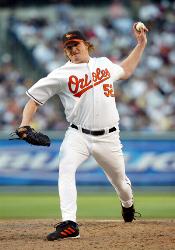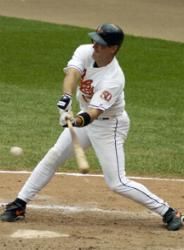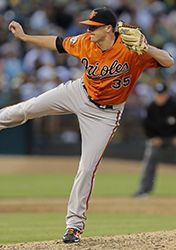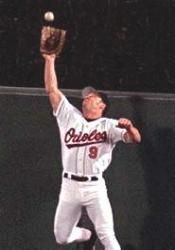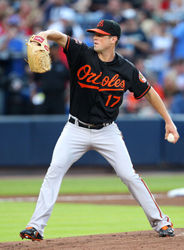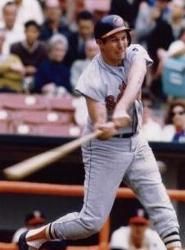
Nickname: The Oriole is the state bird of Maryland. All professional baseball teams Major League or in the Minors that played in Baltimore has been named Orioles. Logo: Orioles written in script with s underscoring the word superimposed over a baseball diamond. While perched on top of the dot in I is an Oriole. Colors: Black Orange |
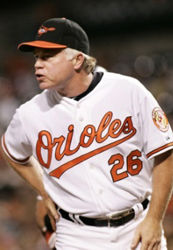
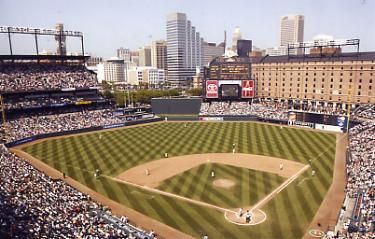
Manager: Dave Trembley 2007- Stadium: Camden Yards 1992- |
Logo 1998-Present |
Address: 333 West Camden Street Baltimore, MD 21201 Phone: (410) 685-9800 Web: http://www.theorioles.com |
Managers: (19) Jimmy Dykes 1954 Paul Richards 1955-1961 Lum Harris 1961 Bill Hitchcock 1962-1963 Hank Bauer 1964-1968 Earl Weaver 1968-1982 Joe Altobelli 1983-1985 Cal Ripken Sr. 1985 Earl Weaver 1985-1986 Cal Ripken Sr. 1987-1988 Frank Robinson 1988-1991 Johnny Oates 1991-1994 Phil Regan 1995 Davey Johnson 1996-1997 Ray Miller 1998-1999 Mike Hargrove 2000-2003 Lee Mazzilli 2004-2005 Sam Perlozzo 2005-2007 Dave Trembley 2007-Present |
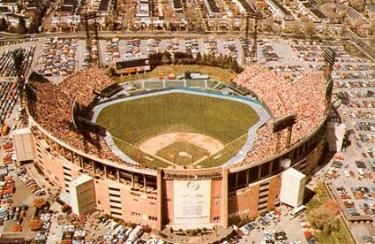
Stadiums: (2) Memorial Stadium 1954-1991 Camden Yards 1992-Present |
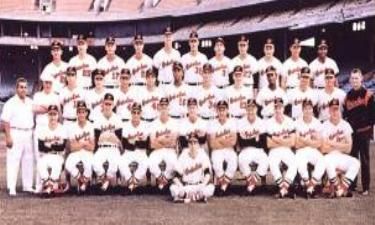
World Champions: (3) 1966, 1970, 1983 World Series Appearances: (6) 1966, 1969, 1970, 1971, 1979, 1983 LCS Appearances: (9) 1969, 1970, 1971, 1973, 1974, 1979, 1983, 1996, 1997 Division Champions: (8) 1969, 1970, 1971, 1973, 1974, 1979, 1983, 1997 Wild Card: (1) 1996 |
Hall of Famers:(11) Luis Aparicio SS 1963-1967 Reggie Jackson OF 1976 George Kell 3B 1956-1957 Eddie Murray 1B 1977-1888, 1996 Jim Palmer RHP 1965-1984 Cal Ripken Jr. SS 1981-2001 Robin Roberts RHP 1962-1965 Brooks Robinson 3B 1955-1977 Frank Robinson OF 1966-1971 Earl Weaver MGR 1968-82, 1985-86 Hoyt Wilhelm RHP 1958-1962 |
Retired Numbers: (7) 4 Earl Weaver MGR 1968-82, 85-86 5 Brooks Robinson 3B 1955-1977 8 Cal Ripken Jr. SS 1981-2001 20 Frank Robinson OF 1966-1971 22 Jim Palmer RHP 1965-1984 33 Eddie Murray 1B 1977-88, 1996 42 Jackie Robinson (Retired by MLB) |
All-Star Games Hosted: (2) 1958, 1993 All-Star Game MVP: (6) 1966 Brooks Robinson 3B 1971 Frank Robinson OF 1991 Cal Ripken Jr. SS 1998 Roberto Alomar 2B 2001 Cal Ripken Jr. 3B 2005 Miguel Tejada SS |
AWARDS Manager of the Year: (2) 1989 Frank Robinson 1997 Davey Johnson Rookie of the Year: (6) 1960 Ron Hansen SS 1965 Curt Blefary OF 1973 Al Bumbury OF 1977 Eddie Murray 1B 1982 Cal Ripken Jr. SS 1989 Gregg Olson RHRP Fireman Award: (2) 1994 Lee Smith RHP 1997 Randy Myers LHP Hank Aaron Award: None Cy Young: (6) 1969 Mike Cuellar LHP 1973 Jim Palmer RHP 1975 Jim Plamer RHP 1976 Jim Palmer RHP 1979 Mike Flanagan LHP 1980 Steve Stone RHP MVP: (5) 1964 Brooks Robinson 3B 1966 Frank Robinson OF 1970 Boog Powell 1B 1983 Cal Ripken Jr. SS 1991 Cal Ripken Jr. SS |
LCS MVP: (1) 1983 Mike Boddicker RHP World Series MVP: (3) 1966 Frank Robinson OF 1970 Brooks Robinson 3B 1983 Rick Dempsey C |
Best Season: 1969 (109-53) Worst Season: 1988 (54-107) |
Odds and Ends: Mascot: The Oriole Bird |
Alternate Logo 2002-Present |
No Hitters: (5) 9/2/1958 Hoyt Wilhelm 4/30/1967 Combined: Steve Barber 8 2/3, Stu Miller 1/3 4/27/1968 Tom Phoebus 8/13/1969 Jim Palmer 7/13/1991 Combined: Bob Milacki 6, Mike Flanagan 1, Mike Williamson 1, Gregg Olson 1 Cycle Hitters: (3) 7/15/1960 Brooks Robinson 5/6/1984 Cal Ripken Jr. 6/29/2007 Aubrey Huff |
On the Air: Televsion: WJT (Channel 13); Mid-Atlantic Sports Network Radio: WHFS (105.7 FM) Broadcasters: Buck Martinez, Jim Palmer, and Gary Thorne-TV; Joe Angel, Jim Hunter and Fred Manfra-Radio Ford C. Frick Recipients: (2) Bob Murphy 1961 Chuck Thompson 1954-88, 1991-04 |
Spring Training History: (6) Yuma, AZ 1954 Daytona Beach, FL 1955 Scottsdale, AZ 1956-1958 Miami, FL 1959-1988 Sarasota, FL 1989-1995 Ft. Launderdale 1996-Present |
©MMVIII Tank Productions. Stats researched by Frank Fleming, all information, statistics,
logos, and team names are property of Major League Baseball. This
site is not affiliated with the Baltimore Orioles or Major League Baseball.
This site is maintained for research purposes only. All logos used on
this page were from Chris Creamer's Sports Logos Page. Page created on April 22, 2001. Last updated on March 9, 2008 at 1:59 am ET. Home |
On The Farm: AAA: Norfolk Tides AA: Bowie Baysox A: Aberdeen IronBirds A: Frederick Keys A: Delmarva Shorebirds R: Bluefield Orioles |

55th Season First Game Played April 13, 1954 |


Historical Moments: 1954: In the first season of the modern Orioles, the team is a success in the stands but a failure on the field. On the field the team manages to lose 100 games, while finishing in 7th Place. However, the team manages to draw over a million fans in 67 home games. 1955: The Orioles continue to struggling finishing in 7th place again with a record of 57-97. 1956: The Orioles show some signs of improvement as they finish in 6th place with an improved 69-85 record. 1957: The Orioles finished at .500 for the first time with a record of 76-76, while finishing in 5th Place. Veteran Connie Johnson led the charge of a surprising Orioles pitching staff that saw 4 pitchers throw shutouts on consecutive days in late June. 1958: The Orioles are unable to build off their .500 season finishing in 6th place with a disappointing record of 74-79. 1959: In a carbon copy of the previous season the Orioles finish in 6th place again with a record of 74-80. 1960: The Orioles made a charge for the pennant, before the New York Yankees over took them with a 15 game winning streak in September. However, finishing with an 89-65 record, it was clear that the future was bright with rookies Jim Gentile, Ron Hansen, and Steve Barber shining bright alongside more established players such as Milt Pappas and Brooks Robinson, who went to the first of his 16 All-Star Games. 1961: The Orioles eclipsed the 90-win mark for the first time finishing 95-67, but still finished 14 games behind the New York Yankees, in 3rd Place. Jim Gentile had a stellar season and set 11 team records, while finishing 3rd in the MVP vote behind Yankees stars Roger Maris and Mickey Mantle. 1962: The Orioles hit a bump in the road and take a step backwards in their development into a winner by finishing in 7th Place with a disappointing 77-85 record. 1963: The Orioles rebound nicely after their poor showing, to finish in 4th Place with a solid 86-76 record. 1964: As late as mid-September the Orioles were in 1st place in a tight pennant race with the New York Yankees and Chicago White Sox. However, the Yankees won 11 straight down the stretch to take the pennant by a game over Sox and 2 games over the Birds, who finished with an impressive 97-65 record. O's 3B Brooks Robinson was named AL MVP hitting .317 with 194 hits, 28 HR, and 118 RBI. 1965: The Orioles are in the thick of the pennant race again, before finishing in 3rd Place, 8 games behind the 1st Place Minnesota Twins with a 94-68 record. 1966: In a trade with the Cincinnati Reds for Milt Pappas and two others, Frank Robinson came to the Birds and proved to be the missing ingredient for the Championship. Robinson ended up winning the AL MVP, and Triple Crown. Frank Robinson, Brooks Robinson, and Boog Powell all drove in over 100 runs; along with a balanced pitching staff the Orioles finished with a 97-65 and cruised to their first AL Championship. In the World Series the Orioles faced the powerful pitching of the Los Angeles Dodgers. The Orioles jumped out quickly with Back-to-back home runs by Frank and Brooks Robinson in the top of the 1st inning of Game 1 that gave the Birds a quick 3-run lead. The O's added a 4thrun an inning later before the Dodgers attempted to come back with single runs in the 2nd and 3rd innings. However, by then Oriole reliever Moe Drabowsky had come on to pitch, and stopped the Dodgers on one hit the rest of the way, striking out 11. The Dodgers would not score again in the Series, as the Orioles claimed their first World Championship with a sweep. Shutting the Dodgers out in the last 3 games was Jim Palmer who out-dueled Sandy Koufax in Game 2, while Wally Bunker, and Dave McNally, who performed the shutout honors in Games 3 and 4. 1967: The Orioles coming off their World Championship, struggle all season tied for 6th place with a disappointing 76-85 record. 1968: The Orioles get off to a slow start again, and Manager Hank Bauer is fired, and replaced by Earl Weaver. Under Weaver the Orioles would make a late charge, before finishing 12 games out of first place in 2nd with a solid 91-71 record. 1969: In Earl Weaver's first full season at the helm, Jim Palmer's dominance was on display as he fired off an 11-game win streak during the summer. Mike Cuellar also stared on the mound winning 23 games, en-route to sharing Cy Young honors with Detroit Tigers Denny McLain. Meanwhile Dave McNally also won 20 games, as the Orioles dominated the AL East, in the first year of divisional play, with a franchise best record of 109-53. In the first every ALCS the Orioles used lat inning rallies to sweep the Minnesota Twins in 3 straight games. Going into the World Series the Orioles were heavy favorites against the New York Mets who were not even supposed to be there. The Series got off to a promising start when Don Buford hit a leadoff homer, and the Orioles won Game 1, 4-1. However in Game 2, Jerry Koosman helped the Mets even the series heading to New York for the next 3 games shut down the Orioles. In Game 3 it was CF Tommie Agee who single handily did in the Birds leading off with a HR, and stealing at least 5 runs with his glove. In Game 4 fate took another strange twist as JC Martin laid down a bunt, O's reliever Paul Richert's throw then hit him allowing the winning run to score in the 10th. Down 3-1 the Orioles needed to win Game 5, and after taking a 3-0 lead looked well on their way to doing just that. However, fate dealt the O's another blow in the 6th when Cleon Jones was hit on the foot with a pitch. Originally Jones was not awarded 1st, bust after Mets coach Yogi Berra showed that shoe polish was on the ball Jones was awarded first. Following was Donn Clendenon who hit a 2 run homer to bring the Mets back into the game. The Mets would tie the game an inning later, and eventually take the lead for good in the 8th with 2 runs. The stunned Orioles only left helpless too watch as Cleon Jones caught Dave Johnson's pop up to win the Series, in perhaps the greatest upset in World Series history. 1970: The Orioles posted three 20-game winners, Dave McNally (24-9) and Mike Cuellar (24-8) leading the way, followed by Jim Palmer, whose 20-10, whose record included 5 shutouts. Boog Powell led the offense hitting 35 HR, and driving in 114 runs en-route to winning the AL MVP. The Orioles again cruised to the AL East title with a 108-54 record. Once again the Orioles swept the Minnesota Twins, in the ALCS on their way to the World Series. The World Series against the Cincinnati Reds ended up becoming the Brooks Robinson show. Robinson, who nailed the game winning HR in the 7th inning of Game 1 gave Red hitters nightmares with his un-worldly play at the 3rd Place through-out the series. The Orioles came back from an early 4-0 deficit to win Game 2, and returned home up 2-0 in the series. Game 3, was won by Dave McNally on the mound and the plate when he hit a 6th inning Grand Slam. After blowing a late lead in Game 4, and trailing early in Game 5 the Birds put the finishing touches on their 2nd World Championship by scoring 9 unanswered runs, and winning the Series 4 games to 1. 1971: Not satisfied with their pitching brilliance in 1970, the Orioles outdid themselves by posting four 20-game winners. Pat Dobson joined McNally, Cuellar, and Palmer as the Birds went on to post a 101-61 record for their 3rd straight AL East title. Again the Orioles got to the World Series with an ALCS sweep, this time the victims were the Oakland Athletics. In the World Series for the 3rd straight year, the Orioles would meet up with Roberto Clemente and the Pittsburgh Pirates. The Orioles got off to a fast start in the fall classic winning the first 2 games at Memorial Stadium by scores of 5-3, and 11-3. However, the Pirates would bounce back to win the next 3 in Pittsburgh including Game 4 which was the first World Series Game ever played at night. The Orioles would bounce back to win Game 6 in 10 innings, but Roberto Clemente and the stellar pitching performance of Steve Blass in Game 7, proved too much to overcome, as the Orioles lost their 2nd World Series in 3 years. 1972: The Orioles quest for a 4th Straight World Series Appearance ends with a 3rd Place 80-74 record, which left them 5 games behind the AL East Champion Detroit Tigers. 1973: The Orioles returned to the top of the Eastern Division, with a 97-65 record. In the ALCS the Orioles took on the Powerhouse Oakland Athletics, and through the first 4 games were tied 2-2. However in the deciding 5th game the Orioles were shut down by Catfish Hunter who led the A's on to their 2nd consecutive World Championship. 1974: The Orioles battled the New York Yankees all season for the division title, and finally pulled away to win their 5th division title in 6 years by sweeping a series against the Yankees in New York to finish with a 91-71 record. In the ALCS the Orioles were confronted again by the Oakland Athletics, who were well on their way to their 3rd straight World Championship. The Orioles did manage to win the first game but Oakland proved to be too powerful winning the next 3 games easily. 1975: The Orioles fall 4 and half games short in a battle with the Boston Red Sox for the AL East Title, settling for 2nd Place with a 90-69 record. 1976: The Orioles acquire slugging OF Reggie Jackson in a trade with the Oakland Athletics. However, Reggie was not happy with Baltimore, and left for a Free Agency deal with New York Yankees, who beat out the 88-74 Orioles by 10 and half games for the Division Title. 1977: Despite the loss of Reggie Jackson, the Orioles find themselves in the midst of a 3-team race for the Eastern Division all season. With Brooks Robinson retiring, the Orioles find a new slugger in Eddie Murray who wins the Rookie of the Year and becomes a fixture at 1st Base for the next 11 years. Murray slams 28 homers and 88 RBI, as the Orioles challenge the Boston Red Sox, and the New York Yankees until the final weekend of the season, before finishing tied for 2nd with a 97-64 record. 1978: The Orioles are never really a factor in the race for the Divisional Title, despite a solid 90-71 record that lands them in 4th Place 8 and half games behind a first place tie between the New York Yankees, and Boston Red Sox. 1979: Orioles Magic came to town, as the Birds always seemed to find a way to win 102 games, and the AL East Title. If it wasn't a home run from someone you least expected it was a late-inning rally that willed the O's to victory. Mike Flanagan took over as the ace of the staff going 23-9 with 16 complete games, 5 shutouts, and a 3.08 ERA on his way to the Cy Young Award. The Orioles found little challenge in the ALCS against the California Angels winning in 4 games, and scoring 26 runs in the 3-1 series triumph. The World Series ended up being a rematch of the 1971 series against the Pittsburgh Pirates, who were bolstered by the Disco hit "We Are Family". The Orioles got off to a fast start scoring 5 runs in the first inning of Game 1. After losing Game 2, the series shifted to Pittsburgh, where the Orioles won Games 3 and 4, establishing a commanding 3 game to 1 series lead. However, the Pirates pitching buckled down, as the Pirates led by veteran Willie Stargell came by to stun the Orioles taking the final 3 including two in Baltimore to win the Series in 7 games. 1980: The Orioles won 100 games behind the brilliant pitching of Scott McGregor (20-8) and Steve Stone (25-7), who went on to win the Cy Young, but finished 3 games behind the New York Yankees for the division title. 1981: In a season interrupted by a 50-day strike the Orioles are a factor for the Division Title before and after the strike, but fail to finishing in 1st Place in either half of the split season posting a 59-46 overall record. In August, Cal Ripken Jr. the son of long time Orioles coach Cal Ripken makes his debut. 1982: In his first full season, Rookie of the Year Cal Ripken Jr. made his presence known early on, going 3-5 with a homer on Opening Day. Eddie Murray made a bid for the MVP award hitting .316 with 32 HR and 110 RBI. On May 30th in the first game of a Memorial Day weekend Double Header Rookie Cal Ripken sits out. Little did anyone know at the time it would be the last game Ripken would miss for 16 years. He would go on to break Lou Gehrig's "unbreakable" record of 2139 consecutive games. The Orioles had an up and down season but made a heroic final charge down the stretch that put them into a tie with Milwaukee Brewers on the final day of the regular season and it was a head-to-head match up. Unfortunately, league MVP Robin Yount and the rest of the Brewers proved to be too much and the Birds finished 1 game back at 94-68. After the season Manager Earl Weaver announced his retirement 15 winning seasons at the helm. 1983: Joe Altobelli became the new manager and took over an Orioles team on a mission. The mission looked to be derailed early by several key injuries to players such as Jim Palmer, Mike Flanagan, Dan Ford, and Tippy Martinez, but the O's stayed the path and won 98 games and division title, as Cal Ripken Jr. took home AL MVP honors. The Orioles faced the Chicago White Sox in the ALCS. After losing the first game, the Birds came back to shut down the White Sox offense and win the series in 4 games. In the World Series the Orioles faced their geographical rival Philadelphia Phillies. The Orioles dropped the Game 1, once again 2-1, and came back top sweep the rest of the series. After losing the opener at Memorial Stadium, Mike Boddicker yielded just three singles, as the Orioles won the 2nd game 4-1. The Phillies scored first in Game 3, on leadoff home runs in the 2nd and 3rd innings by Gary Matthews and Joe Morgan. However, the Orioles finally got to veteran starter Steve Carlton in the 6th, and drove him out of the game by scoring 3 runs. The Orioles also would win Game 4 by a single run. Home runs by Series MVP Rick Dempsey and Eddie Murray (who hit two) accounted for 4 of the Orioles 5 runs in the final game, which was more than enough to support Scott McGregor's 5-hit shutout pitching giving the Orioles the 3rd World Championship. 1984: The Orioles celebrate their 30th Anniversary, but are unable to defend their World Championship, finishes in 5th Place with an 85-77 record. Hall of Fame pitcher Jim Palmer who struggled with injuries would retire early in the season failing to win a single game. 1985: After a slow start the Oriole fire Manager Joe Atobelli and lure Earl Weaver out of retirement to replace him. However, the Orioles still finish in the middle of the pack with an 83-78 record that landed them in 4th Place. 1986: The Orioles 18-year streak of winning seasons comes to an end with a last place 73-89 finish. Following the season Earl Weaver, would retire again. 1987: To replace Weaver, the Orioles hire Cal Ripken Sr. to manage the ball club. The Move fails to produce results and the falling Orioles lose 95 games. However, the season is highlighted by the debut of Billy Ripken, who would go on to play 2B right besides his brother Cal for the next several seasons. 1988: The Orioles hit rock bottom posting an awful 54-107 record. The Orioles were bad from the start losing their first 21 games, setting a Major League record for the most losses to start a season an for the longest losing streak in AL history. The start would se Cal Ripken Jr. fired just 6 games in the season as Oriole legend Frank Robinson was brought in to try and revive the team. 1989: The Orioles had new uniforms and a new attitude on display as the team improved by 32 games with an 87-75 record. Along the way the Oriole spent nearly 3 months of the season in first place, before losing the Division Title on the next-to-last day of the season following consecutive 1-run losses to the Toronto Blue Jays. The Orioles dramatic run, became known as the "Why Not?" season as Frank Robinson won the American League Manager of the Year for his role in leading this young group into a pennant chase. 1990: The Orioles came back to earth following their surprising run for the Division Title, finishing with a 76-85 record that saw them finish in 5th Place. 1991: The final season for Orioles baseball on 33rd Street saw the Orioles struggle to finish in 6th Place with a 67-95 record. However, Cal Ripken Jr. had a career year, hitting .323 with 210 hits including 34 HR, 144 RBI, 368 total bases, and only 46 strikeouts. He would go on to win the MVP, All-Star MVP, and Major League Player of the Year Awards. Mike Flanagan pitched the last inning of the last game ever at Memorial Stadium retiring the batters 1-2-3. After the game a magical ceremony that included over 100 Orioles Greats bid farewell to the stadium and transplanted home plate from Memorial Stadium to the new Stadium at Camden Yards to officially end one era and begin a new one. 1992: The dawn of a new era of Orioles baseball began as Camden Yards was introduced to the world, as the premiere ballpark in baseball. Despite many comments about how hitter-friendly the park was, the first 3 games played there were low-scoring shutouts with the Birds winning 2 of them. The Orioles would go to finish in 3rd Place with a solid 89-73 record. 1993: In a streaky 85-77-season the Orioles, who hosted the All-Star Game finished in a tie for 3rd Place. 1994: The Orioles were in 2nd Place and well within contention for either the Wild Card, or Division Title when a strike ended the season pre-maturely on August 12th with a record of 63-49. The strike would also put Cal Ripken Jr's consecutive games streak in jeopardy. At the start of the 1995 pre-season the player's were still at the picket lines, and replacement player's were used in Spring Games by every team except the Orioles, who's owner Peter Angelos refused to use them. Had the season started with replacements Ripken's streak now fully within reach of Lou Gehrig's record 2130 consecutive games would have ended. However a circuit judge declared an impasse allowing the players to comeback, and ending the strike just a few days before the season was originally set to begin. This would keep Ripken's streak alive, set up him to break the record in early September. 1995: With many fans scorned by the strike Cal Ripken Jr's pursuit of the Consecutive Games record became a way for baseball to get some positive press. On September 5th and 6th at Camden Yards against the California Angels, Cal Ripken Jr. became baseball's all-time "Iron Man", tying and breaking Lou Gehrig's consecutive games played record of 2,130. In the 2 games Cal went a combined 5-9 and hitting home runs in each game. Ceremonies were held after the tying game and included a "roast" of Cal to congratulate him on his achievement, but the best celebration was to come during the record-breaking game. After the game was in the books as an official game, play was halted for over 20 minutes as Cal Ripken Jr. made a victory lap as the fans showed their appreciation for baseball's new "Iron Man". However, during the season the Orioles would not fair as well fading late in the season to finish in 3rd Place with a disappointing 71-76 record. 1996: After a frustrating first half, which saw the team struggle to find their identity, the Birds made a charge and captured the A.L. Wild Card with an 88-74 record. The season was also highlighted by the return of Eddie Murray who hit his 500th HR at Camden Yards on the 1-year anniversary of Cal Ripken Jr. breaking Lou Gehrig's record. In the Division Series against the Cleveland Indians, Roberto Alomar secured victory for the Orioles with his heroics on the field and at the plate, as the O's stunned the Indians in 4 games. The Orioles moved on to face the New York Yankees in the ALCS. The Orioles lost Game 1 after a controversial homer by Derek Jeter that was aided by a fan who stuck his glove out over the fence to pull it in for a homer. The Orioles would bounce back behind the pitching of David Wells to send the series back to Camden Yards tied at one game apiece. However, home provided no comfort for the Orioles who lost all 3 games at Camden Yards to the Yanks, who advanced to the World Series in 5 games. 1997: The Orioles had a potent attack, led by Rafael Palmeiro, Roberto Alomar, and B.J. Surhoff, along with double digit wins from 5 Orioles pitchers to lead the propelled the Birds to lead the AL East from wire to wire, beating out the New York Yankees by 2 games with a 96-66 record. In the ALDS the Orioles dispatched the Seattle Mariners in 4 games beating Randy Johnson twice. Their dominance brought them to the ALCS for a rematch with the Cleveland Indians in the ALCS. The Orioles got off to a fast start winning Game 1, and leading Game 2 in the 9th Inning, before Reliever Armando Benitez surrendered a game-tying homer to Marquis Grissom. The Indians would go on to win the game in extra innings, and would go on to take the series in 6 games, as the O's lost 3 heart breaking games in extra innings. 1998: In a disappointing season, which sees the Orioles fall out of the race early, Cal Ripken Jr's streak makes news again on September 20th. After 2,632 consecutive games played the streak came to an end, as Ripken decides to take a game off. He decides to take off on the final Sunday Home game of the regular season so Orioles fans can tell their grandchildren they were there the night Cal Ripken Jr. sat out. The Orioles would go on to finish in 4th place with a record of 79-83. 1999: The Orioles make history by playing 2 games against the Cuban National Team. In the first game at the end of spring training the Orioles became the first American team to play in Cuba in 40 years, with a 3-2 win. The Cuban National team would return the favor beating the Orioles in an exhibition game at Camden Yards in May. In a season marked by pain, and personal loss Cal Ripken Jr. misses large chunks of the regular season with an injured back. The personal loss comes when his father passes away from lung cancer prior to the start of the season. The highlight of the season comes on June 13th in an interleague game in Atlanta where Ripken goes 6 for 6 in a rout over the Braves. However the injuries would prevent Ripken form reaching the 3,000 hit milestone leaving him just 9 short heading into the next season. However, Ripken does manage to hit his 400th career HR, as the Orioles finish in 4th Place with a 78-84 record. The Orioles see another one of their players reach a career milestone when pitcher Jesse Orosco pitches in his MLB record 1,072nd game on August 17th. 2000: It does not take long for Cal Ripken to get his 3,000th hit, as he reaches the milestone on April 15th with a 7th inning single in Minnesota against the Twins. However the year is plagued with injury and frustration again as Ripken misses half of the season, and the Orioles finish with a 74-88 record. 2001: An otherwise forgettable 63-98 season is marked by the end of the Ripken era in Baltimore. After 20 seasons Cal Ripken Jr. decides to retire, and the season becomes a farewell tour for Cal. The farewell tour officially got started in the All-Star Game where Cal Ripken Jr. won the game's MVP with a homer off Chan Ho Park. Ripken would have a habit of hitting homers in each of final series at a particular stadium. However, it was clear his best days were behind him as he struggled to hit .239. Prior to his final game on October 6th, Orioles, and baseball honored Ripken, as a new award was established in his honor awarding players who don't miss a game with the Cal Ripken Jr. Award. 2002: In their first season without Cal Ripken Jr. the Orioles who were in the middle of a youth movement were playing well beyond expectations as they hovered around .500 most of the first 5 months holding a 63-63 record on August 23rd while starting pitcher Rodrigo Lopez with 14 wins and closer Jorge Julio with 31 saves were making serious runs at Rookie of the Year. However, suddenly and without warning the bottom would fall out. The Orioles would win just 1 of their next 19 games and 4 of their last 36 including a 12 game losing streak to close out the season with a 67-95 record to finish in 4th place. Lopez would win just 1 game down the stretch while Julio did not post a save in any of the Orioles final 4 wins, costing either a shot at winning top rookie honors. 2003: The Orioles showed signs of improvement, as they played hard in every game with a league high 79 games decided by 1 or 2 runs. However playing in the same division as the New York Yankees, Boston Red Sox and Toronto Blue Jays the Orioles were quickly lost in the shuffle and on their way their way to a 6th straight season in 4th place. As they had in previous years the Orioles dealt away several players at the trade deadline getting themselves up for a dreadful final 2 months as they finished with a 71-91 record. Following the season the Orioles would fire Manager Mike Hargrove and would attempt to improve themselves through free agency signing Javier Lopez and Miguel Tejada, while bringing back former Orioles Rafael Palmeiro and Sidney Ponson who was traded to the San Francisco Giants at the trade deadline. 2004: In their first season under Manager Lee Mazzilli the Orioles offense was one of the strongest in the American League as they hit .281 as a team, as Miguel Tejada led the Majors with 150 RBI. However their pitching was a major weak spot particularly in the first half of the season as the Orioles suffered through an awful 8-19 June, falling out of the playoff race. With the hiring of Ray Miller as the team's pitching coach the Orioles pitching was better in the second half posting a 3.01 ERA in September. However it would not help the Orioles finish above .500 as they finished 3rd with a record of 78-84. 2005: As Spring Training was about to begin the Orioles added more punch to their already strong line up acquiring Sammy Sosa from the Chicago Cubs in trade for Jerry Harriston Jr. The trade would fizzle from the start as Sosa clearly past his prime, and perhaps hurt by the steroids ban only hit 14 homers with 45 RBI and a terrible .221 average. Despite the lack of production from Sosa the Orioles got off to an excellent start as 2B Brian Roberts had a break out year hitting .358 with 11 homers through the first 2 months as the Orioles were in 1st place with a 31-20 record. Along the way Rafael Palmeiro received the recognition he deserved by collecting his 3,000th career hit to become just the 4th player in baseball history to have 3,000 hits and 500 Homers. While in the pen the Orioles were getting solid relief from B.J. Ryan who had a break out year with 36 saves. The Orioles continued to play well into June as they held a 42-28 record on June 21st. However, on the horizon laid storm clouds as things would fall apart quickly first Roberts suffered an injured elbow and was not quite the same the rest of the year, while the poor Orioles starting pitching began to catch up with them as they lost their grip on first place losing 12 of 17 games, heading into all star break. At the All-Star Game SS Miguel Tejada would capture MVP honors, and the Orioles came out strong winning their first 2 game after the break. However, those storm clouds rolled in and washed all the hope and optimism away as the Orioles went into a total free fall losing 16 of their next 18 games, along the way Rafael Palmeiro had his entire career forever tarnished as he became the first notable player to receive a steroids suspension. When 3 months earlier he seemed to had secured his Hall of Fame Plaque, now he's found himself inducted into the Hall of Shame as fans everywhere turned against him, while he earned the scorn of teammates as while grasping for alibis seemed to implicate Tejada. With the team imploding the Orioles would fire Manager Lee Mazzilli and replace him with Sam Perlozo in August. Perlozo would not do much better as the Orioles who once stood atop a 1st Place perch sat in 4th place with a 74-88 record when the season was over. Making matters worse their breakout closer B.J. Ryan broke free and signed with the Toronto Blue Jays, while SS Miguel Tejada sulked all winter and demanded a trade. 2006: The Orioles were unable to deal Miguel Tejada much to the star Shortstops chagrin as the Orioles were clearly a team rebuilding with youth. However, they did attempt to make some improvements with the acquisition of Kris Benson from the New York Mets for Jorge Julio and pitching prospect John Maine, while signing Kevin Millar of the Boston Red Sox. While Benson pitched well early posting a 9-5 record through the first two months he struggled the rest of the way and ended the season with a disappointing 11-12 record with a 4.82 ERA, while Millar batted a serviceable .272 with 15 homers and 64 RBI. The unhappy Tejada was more then professional having a solid .330 average with 24 home runs and 100 RBI. However the Orioles were as bad as expected as they finished in 4th Place with a 72-90 record. However, there were some important bright spots as rookies like Nick Markakis who hit .291 with 16 HR, and 62 RBI, and Adam Loewen who had a 6-6 record and showed some flashes of brilliance gave Orioles fans hope for better days ahead. 2007: The Orioles started the season down a man as Kris Benson was lost for the entire season, while Miguel Tejada continued to sulk on a Orioles team that going into the season was seen as having no chance against the World Class New York Yankees and Boston Red Sox. After posting a 27-27 record over the first two months, the Orioles plunged deeper in June, losing 13 of 15 games, including eight straight costing Manager Sam Perlozo his job on June 18th. Under replacement Dave Trembley the Orioles losing streak would hit nine, but the Orioles would soon turn things around, highlighted by a 15 strike out performance from Eric Bedard on July 7th as they posted a 12-5 record in the second half of July after the All-Star Break. With the Orioles playing more competitive baseball the team decided to give Trembley a contract extension on August 22nd, unfortunately that night in the first game of a twi-night double header against the Texas Rangers the Orioles would lose 30-3, in the biggest blowout in the history of the modern era. It would be the first loss of a nine game losing streak as the Orioles finished another season for the birds in fourth place with a record of 69-92. |