Nickname:
Named after the State of  Texas' elite Law Enforcement agency.

Colors
:
Blue
White
Red
 
Manager:
 
Ron Washington 2007-

Stadium:
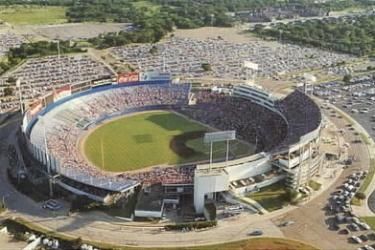
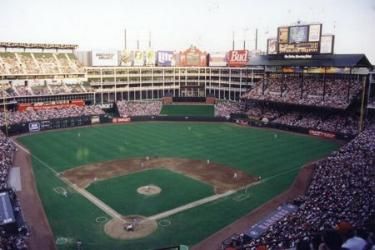
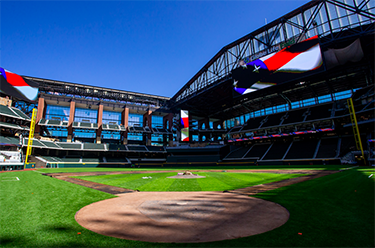
Rangers Ballpark in Arlington * 94-
*-Known as The Ballpark in Arlington 1994-2004;  Ameriquest Field 2005-2006
 
Logo
2003-Present
38th Season
First Game Played April 15, 1972



Address:
1000 Ballpark Way #400
Arlington, TX 76011
Phone: (817) 273-5222


Web:
http://www.texasrangers.com


Managers: (19)
Ted Williams 1972
Whitey Herzog 1973
Del Wilber 1973
Billy Martin 1973-1975
Frank Lucchesi 1975-1977
Eddie Stanky 1977
Connie Ryan 1977
Billy Hunter 1977-1978
Pat Corrales 1978-1980
Don Zimmer 1981-1982
Darrell Johnson 1982
Doug Rader 1983-1985
Bobby Valentine 1985-1992
Toby Harrah 1992
Kevin Kennedy 1993-1994
Johnny Oates 1995-2001
Jerry Narron 2001-2002
Buck Showalter 2003-2006
Ron Washington 2007-Present


Stadiums: (2)
Arlington Stadium 1972-1993
Rangers Ballpark in Arlington 94-P
*-Known as The Ballpark in Arlington 1994-2004; Ameriquest Field 2005-2006
 
World Champions:
None

World Series Appearances:
None

LCS Appearances:
None

Division Champions
: (4)

1994*, 1996, 1998, 1999

*-Strike ended season on Aug. 12th

Wild Card:
None


Hall of Famers: (4)
Goose Gossage RHRP 1991
Ferguson Jenkins RHP 74-75, 78-81
Gaylord Perry RHP 1975-1977, 1980

Nolan Ryan RHP 1989-1993


Retired Numbers: (3)
26 Johnny Oates 1995-2001
34 Nolan Ryan RHP 1989-1993
42 Jackie Robinson
(Retired by MLB)
 
 
All-Star Games Hosted: (1)
1995

All-Star Game MVP
: (3)
1990 Julio Franco 2B
2004 Alfonso Soriano 2B
2006 Michael Young SS
 
 
AWARDS
Manager of the Year: (2)
1996 Johnny Oates
2004 Buck Showalter


Rookie of the Year: (1)
1974 Mike Hargrove 1B

Fireman Award: (2)
1979 Jim Kern RHP
1989 Jeff Russell RHP


Hank Aaron Award: (3)
2001 Alex Rodriguez SS
2002 Alex Rodriguez SS
2003 Alex Rodriguez SS


Cy Young:
None

MVP: (5)
1974 Jeff Burroughs OF
1996 Juan Gonzalez OF
1998 Juan Gonzalez OF
1999 Ivan Rodriguez C
2003 Alex Rodriguez SS

 
LCS MVP:
None

World Series MVP:
None


Best Season:
1999 (95-67)

Worst Season
:
1973 (57-105)
 
 
Flag Patch
2001-Present
No Hitters: (5)
7/30/1973 Jim Bibby
9/22/1977 Bert Blyleven
6/11/1990 Nolan Ryan
5/1/1991 Nolan Ryan
7/28/1994 Kenny Rogers
(Perfect)

Cycle Hitters: (4)
7/23/1985 Oddibe McDowell
8/17/2004 Mark Teixeira
9/13/2006 Gary Matthews Jr.
4/15/2009 Ian Kinsler

 
On the Air:
Televsion:

KDFW (Channel 4); KDFI (Channel 27); Fox Sports Net Southwest

Radio
:
KRLD (1080 AM); KFLC (1270 AM)- Spanish

Broadcasters
:
Tom Greive, Jim Knox, and Josh Lewin- TV; Dave Barrett and Eric Nadel-Radio; Jose Guzman and Eleno Ornelas-Spanish


©MMIX Tank Productions. Stats researched by Frank Fleming, all information, statistics, logos, and team names are property of Major League Baseball.  This site is not affiliated with the Texas Rangers or MLB.  This site is maintained for research purposes only. All logos used on this page were from Chris Creamer's Sports Logos Page.
Page created on August 18, 2001. Last updated on July 11, 2009 at 2:35 am ET. 
Home


Spring Training History: (3)
Pompano Beach, FL 1972-1986
Port Charlotte, FL 1987-2002
Surprise, AZ 2003-Present
 
Mascot:
Rangers Captain
On The Farm:
AAA: Oklahoma Red Hawks
AA: Frisco RoughRiders
A: Backersfield Blaze
A: Hickory Crawdads
A: Spokane Indians
R: Arizona League Rangers


Played As:
Washington Senators
1961-1971

Texas Rangers
1972-Present
Historical Moments:

1972: After getting approval to move to Texas, the Senators change their nickname to the Rangers in honor of the famous Law Enforcement Agency. The Rangers would be playing in a converted minor league stadium in Arlington, Texas a suburb of the Dallas-Fort Worth Metropolitan Area. However, fans waiting to see the Rangers first game on April 6th were disappointed as a Player's Strike delayed the start of the season. The strike would relatively quickly, and the Rangers finally played their first game in Anaheim on April 15th, and lost 1-0 pitcher's duel to the Angles. The Rangers would bounce back to win the next game. Five days later on April 21st against the same Angels the Rangers made their Texas debut in front of 20,105 at Arlington Stadium. The Rangers got off to a fast start as Frank Howard homered in the first inning, and would go on to win the game 7-6. However, the Rangers would not win much that first year finishing last with a woeful 54-100 record.

1973:
During an awful 56-105 season it is clear the team has to do something to draw fans attention. When the Rangers drafted Houston High Schooler David Clyde with first over all pick, they decide to start him in the majors right away, and he makes his debut on June 27th just 22 days after being drafted. In Clyde's debut he strikeout the side in the first inning after walking the first two batters. Clyde would go on to win he debut 4-3. However, the move would not work out in the end as Clyde's career would only last five years in which he only won 18 games. The other highlights of the season came when Jeff Burroughs hits three grand slams in ten days at the end of July. During the same stretch Jim Bibby pitches the first no-hitter in franchise history by blanking the eventual World Champion Oakland A's 6-0.

1974:
In the season where baseball finally caught on in the Dallas Metro-area, the Rangers are the surprise of the American League all year, and challenge the Oakland A's for the American League Western Division title. Leading the charge is fiery manager Billy Martin, who takes a team that lost 105 games the year before and transformed them into an 84-76 contender that finishes just five games behind the three time World Champion Athletics. One key to the turn around was the acquisition of Ferguson Jenkins form the Chicago Cubs, in his first season in Texas Fergie wins 25 games tying Catfish Hunter for the most in the American League. While Fergie led the charge on the mound Rookie of the Year Mike Hargrove, and MVP Jeff Burroughs spurred on the offense.

1975:
The Rangers fall back to earth, and finish in third Place with a disappointing 79-83 record. Billy Martin the popular manager of the Rangers is fired in the middle of the season after a fall out with, management. He would land just a few weeks later in the same post with New York Yankees, for what will be the first of five turbulent tenures as manager of the Bronx Bombers. 

1976:
The Rangers continue to struggle as they finish in fourth place with a record of 76-86.

1977:
After a slow 31-31-start the Rangers fire manager Frank Lucchesi. Over the next week the Rangers try out 2 different coaches before hiring long-time Baltimore Orioles coach Billy Hunter. The moves works as Ryan leads the Rangers to 60-33 record over the remainder of the season. The surge would land the Rangers in second place with a 94-68 record, but they could only get within eight games of the first place Kansas City Royals. The highlight of the surge came on August 27th in New York, when Toby Harrah, and Bump Willis hit back-to-back inside the park homers.

1978:
The Rangers are part of a three way race for the AL West Title with the Kansas City Royals and California Angels, before finishing tied for second place with an 87-75 record. Leading the way is Bobby Bonds and Richie Zisk who each hit more then 20 Homers. While on the mound Ferguson Jenkins, who was reacquired in the off-season leads the way with 18 wins, and a 2.27 ERA.

1980:
On May 3rd Ferguson Jenkins becomes the fourth player to win 100 games in each league by beating the Baltimore Orioles 3-2 at Arlington Stadium. Jenkins would go on to have a disappointing 12-12 record with a 3.77 ERA, while the Rangers settled for fourth Place with a 76-85 record.

1981:
Newly acquired Left Handed pitcher Rick Honeycutt gets off to a fast start by collecting four straight shutouts in April. The Rangers find themselves embroiled in a tight race with the Oakland Athletics, as a player's strike loomed in early June. With the strike looming the Rangers were in first place by a half of game, but after the Rangers blew 3-1 lead on the day before the strike start, and were forced to look up at the A's. Had the Rangers held on to win that game they would have been in first when the strike started, thus earning them a trip to the post season as first half champions since baseball decided to split the season. Once games resumed in August the Rangers struggled, and were never a factor in the second half posting an overall record of 57-48.

1982:
The Rangers struggle all season as they finish in sixth place with a woeful 64-98 record. Despite the struggle for one magical week Outfielder Larry Parish was the best player in baseball. Between July 4th& 10th Parrish ties a major league record with three grand slams in one week, and collects 19 RBI while batting .514.

1983:
On July 3rd the Rangers set a major league record by scoring 12 runs in an extra inning. In that magical 15th inning the Rangers send 16 batters to the plate at Oakland to post a 16-4 victory over the Athletics. The Rangers would go on to finish the season with a 77-85 record good enough for third place in the West.

1984:
A disappointing last place 69-92 season is punctuated by a Perfect Game thrown by California Angels Mike Witt on the final day of the season at Arlington Stadium.

1985:
The Rangers finish in last place for the second year in a row as they narrowly avoid a 100-loss season with a record of 62-99.

1986:
After losing 99 games in 1985, the Rangers jump up to challenge the California Angels for the Western Division Title before falling five games short with an 87-75 record. Leading the charge are Rookies Pete Incavigilia who hits 30 home runs, and Ruben Sierra who hits 16 home runs. The rookies were not the only ones going deep for the Rangers veterans Larry Parrish, and Pete O'Brien each hit more then 20 home runs, and drove in more then 90 runs. 

1987:
The Rangers and California Angels battle for positioning again. However, this time it is to avoid last place, as the Rangers post a disappointing 75-87 record while finishing tied for the worst record in the American League West.

1988:
The Rangers continue to struggle as they finish in sixth place with a woeful record of 71-91. After two poor seasons, and a history without a championship of any form the Rangers are regarded as the least valuable franchise in baseball. Complicating matters is Arlington Stadium; a converted minor-league stadium without luxury boxes was not helping the team make any money. Arlington Stadium was thought of so poorly, that it was never considered to host an All-Star Game. This all contributed to instability at the top, as the Rangers were sold to the fourth owners in just 17 years. However, this ownership group would be different, as among their plans was to get the team a new stadium, and transform the club into contenders. George Walker Bush, and Edward Rose head the group up. Bush becomes the figurehead as his father was in his first few months as President of the United States, after eight years serving as Vice President. With this political influence, a new ballpark would only be a matter of time and planning, but contending would be much harder.  

1989: Prior to the season in an attempt to draw more fans, the Rangers sign 42-year-old free agent pitcher Nolan Ryan. The move works as Nolan has a great season winning 16 games while leading the American League with 301 strikeouts. While collecting 300 strikeouts for sixth time in his career Nolan already the all time career leader, collects career strikeout number 5,000 on August 22nd against Rickey Henderson of the Oakland A's. The Rangers would go on to finish in fourth place with an 83-70 record, as Ruben Sierra led the American League In RBI with 119. 

1990:
The Ryan Express continues to roll down the track at age of 43. In his second season with the Rangers Nolan Ryan wins 13 games and leads the League in strikeouts for the 11th time in his great career. However, it is the other milestones that Nolan collects that get all the headlines. First on June 11th in Oakland Nolan Ryan becomes the oldest pitcher ever to throw a no hitter against the A's. It was the record sixth of his career, almost 10 years after his fifth one. Then on July 31st at Arlington Stadium Nolan Ryan earns his 300th career win with 11-3 victory against the Milwaukee Brewers. The milestones have little effect on the Rangers playoff drive as the team finishes in 3rd Place with an 83-79 record.

1991:
On May 1st the big news is Rickey Henderson who steals the 939th base of his career establishing a new record. However, by the time midnight struck he would have to share the spotlight. Just hours after Rickey's record breaker, Nolan Ryan throws his 7th, and final career no-hitter in a 3-0 win over the Toronto Blue Jays at Arlington Stadium. His seven career no hitters are three more then his nearest competitor, and at 44 years, three months and one day, Ryan is the oldest pitcher ever to throw a no-hitter. Nolan would go on to win 12 games that year helping the Rangers to their third straight year with wins in the mid-80's.

1992:
As construction begins on a new ballpark the Rangers suffer through a disappointing fifth place 77-85 season. Even Nolan Ryan shows his age finishing with a 5-9 record with a 3.72 ERA. In a move to shake things up the Rangers trade Ruben Sierra to the Oakland Athletics for Jose Canseco at the trading deadline.

1993:
All good things must come to an end, as after 27 years 1993 would be the last stop on the Nolan Ryan Express. However, the season in which was supposed to be a victory tour is cut short by injuries, as Ryan is limited to just 13 starts, as the arm which dominated baseball for nearly three decades ran out of gas. Event though he did not go out in a blaze of glory, there is no doubt that the next stop for the Ryan Express is the Hall of Fame, and Cooperstown. The season also marks the end of Arlington Stadium as the Rangers look to be a strong contender for the American League West Title. However, the Rangers title chances take a hit when Jose Canseco injures himself pitching in a blowout loss at Boston. The injury shelves Canseco for more then half of the season as the Rangers fall eight games short of the West title with an 86-76 record.  

1994:
The Rangers finally get a ballpark; built for themselves as the state of the art Ballpark in Arlington opens its doors. The Rangers begin their new era on a disappointing note as the Rangers lose the home opener on April 11th against the Milwaukee Brewers. The highlight of the new ballpark comes on July 28th as Kenny Rogers throws a Perfect Game against the California Angels. However, the season is filled with disappointments as the Rangers struggle all year and fall 10 games below .500. However, in the restructured AL West it is good enough for first Place, and as August begins the Rangers are the best of a bad lot leading a division in which all four teams are more then ten games below .500, with a record of 52-62. However, the season would end prematurely as a player's strike that began on August 12th would go on to cancel the rest of the regular season and playoffs. However, since the Rangers are in 1st they collect their first division title, but are still without a postseason appearance. The Rangers change ownership again as the Bush group sells the team after the opening of the new stadium. However, the group did what it set out to do it gets a new stadium, turns the team into a contender, and even lands the franchise its first All-Star Game which would be in 1995. The group turns one of sport's least valuable franchises into a stable viable team for years to come. While the sale was being finalized owner George W. Bush was making a successful run for Governor of Texas.

1995:
Coming back from the strike The Ballpark in Arlington host the All-Star Game, but few fans pay much attention as the strike has many fans still angry. The Ballpark is sold out, but the game collects the lowest Television Ratings in its history. For the season the Rangers finish with a 74-70 record good enough for third place, four games out of first in the Western Division.

1996:
With American League MVP Juan Gonzalez establishing new club records in home runs with 47 and RBI with 144 the Rangers grab the lead in the Western Division early. With the Seattle Mariners being the only other team in contention, the Rangers went into late September holding a small, but comfortable lead in the West. On September 27th in front of a full house in Arlington the Rangers finally dispatched 25 years of frustration by winning the division title and earning a trip to the postseason while posting a solid 90-72 record. In the Rangers first postseason series they faced the New York Yankees, a team that has more postseason experience then any other franchise in the Division Series. The Rangers got off to a fast start by winning Game 1 in historic Yankee Stadium 6-2. Leading the way was the 1-2 punch of Juan Gonzalez and Ivan Rodriguez. The Rangers would also get off to a fast start in Game 2 as Juan Gonzalez continued to slam Yankees pitching. However, the Yankees would rally, and when 3B Dean Palmer threw away a bunt in the 12th the series was tied at one game apiece. As the series came to Arlington a sellout crowd greeted the Rangers who were hosting their first Playoff game. The Rangers would hold a 2-1 lead into the ninth Inning, but the bullpen could not close the deal as the Yanks rallied again to take a 2-1 series lead. In Game 4 with their backs to the wall the Rangers jumped out to a 4-0 lead as Juan Gonzalez went deep for the fifth time in the series. However, the bullpen could not hold the lead, and the Yankees would chip away, before taking the lead for good in the seventh inning, to close out the series 3 games to 1.    

1997:
On June 12th The Ballpark at Arlington hosts the 1st Interleague Game in regular season history. Rangers pitcher Darren Oliver throws the first pitch as the San Francisco Giants win the game 4-3. The Rangers also made another Interleague first as Bobby Witt goes deep on June 30th at Dodger Stadium to become the first American League pitcher to hit a home run in a regular season game in 25 years. However, despite the Interleague highs the team suffers disappointing lows, as they fall to third Place with a disappointing 77-85 record.

1998: After a disappointing season, the Rangers bounce back to reclaim the division title with an 88-74 record. Also returning to top form was Juan Gonzalez who won his second MVP award in three years by hitting 45 home runs and driving in 157 runs. In the Division Series the Rangers were matched up against the New York Yankees again. However, the series would be over quickly as the Rangers offense sputtered and only scored one run during the three game sweep. In the final game played at The Ballpark in Arlington the Rangers had added misery of sitting around more than three hours because of a rain delay. When the game finally resumed a sparse crown watched the Rangers fall 4-0. 

1999: The 1-2 punch of Juan Gonzalez and Ivan Rodriguez is given even more punch as Rafael Palmeiro is reacquired as a Free Agent. Palmeiro hits 47 home runs and 147 RBI while Juan Gonzalez and American League MVP Ivan Rodriguez both drive in more then 100 runs and smack over 30 home runs. The trio is joined by outfielder Rusty Greer who also reaches the century mark in RBI as the Rangers score 945 runs and hit .293 as a team. The Rangers would go on to win a club record 95 games to win their thirrd Division Title in four years. However, in the ALDS the Rangers appeared intimidated as they faced the New York Yankees once again. The Yanks would sweep the Rangers again this time winning the three games by a combined score of 14-1. After the season the Rangers would stun baseball by trading Gonzalez to the Detroit Tigers in a multi-player deal.

2000:
The Rangers offense continues to be strong as Ivan Rodriguez and Rafael Palmeiro both get off to strong starts. However, Rangers pitching is among baseball's worst as the club falls into last place. Then the season goes from bad to worse as an injury sidelines Rodriguez for the rest off the season, but Pudge still manages to hit 29 home runs despite only playing in 91 games. The Rangers would go on to finish with a disappointing 71-91 record. After the season the Rangers shock baseball by signing Alex Rodriguez away from the Seattle Mariners with a record ten year $ 250 million deal. In an interesting side note former Texas Rangers owner who was also served as Governor of Texas George W. Bush received the Republican nomination for President, and was entrenched in the tightest race in Presidential History, winning by the slimmest margin possible. The race was so tight that it was disputed in courts over a month. Bush would go on to become the second son of a president to serve as President, as well as the first sports owner to become President. President Bush, not forgetting his roots even installed a small baseball field on the White House lawn for Washington area Little Leaguers to use. 

2001:
With the singing of Alex Rodriguez, the Rangers have one of the strongest lineups in baseball history, with A-Rod leading the way by hitting 52 home runs, and winning the Hank Aaron award. However, they also have one of the worst pitching staffs in baseball history as the team compiled an awful 5.71 ERA on the way to a last place 73-89 season. Early in the season Manager Johnny Oates, would suddenly resign sighting fatigue. Sadly the fatigue would later be linked to brain tumor, that would claim his life.

2002:
Juan Gonzalez is welcomed back to Texas as he signs a Free Agent Deal prior to the start of the season. However Gonzalez is limited to just 70 games, and 35 RBI. Meanwhile his former MVP counterpart Ivan Rodriguez also struggles with injuries missing more then 50 games. However, offense was not a problem for the Rangers as Alex Rodriguez continued to be the premier player in the American League with a Major League best 57 home runs and 142 RBI, as he captured the Hank Aaron Award for the second straight season. However, any chance of winning the MVP was taken away by the Rangers pitching staff which was awful again posting an ERA 5.16, while dealing with a bullpen that blew 32 late inning leads, as the Rangers finished in last place for the third year in a row with a 72-90 record. Following the season the Rangers would let go Ivan Rodriguez in a cost cutting move, while hiring Buck Showalter as the team's new manager. In Showalter they have a proven winner who had played key rolls in the building of the New York Yankees recent dynasty and Arizona Diamondbacks quick rise for expansion to Champions.

2003:
Under new Manager Buck Showalter the Texas Rangers continued to struggle with terrible pitching as they posted an Major League worst team ERA of 5.67, on the way to finishing in last place for a 4th straight season with a 71-91 record. The terrible pitching would once again overshadow the great individual accomplishments of Alex Rodriguez who hit a Major League best 47 homers, while becoming just the second player to win the MVP award despite playing on a last place team. In addition Rafael Palmeiro achieved his career milestone 500th homer in another solid 38 homer 112 RBI season. While in the All-Star Game Hank Blalock would secure home field for the American League in the World Series with a game winning two run homer in the eighth inning of Los Angeles Dodgers closer Eric Gagne who did not blow any saves during the regular season. However with a payroll over $100 million following the season the team decided to hold a fire sale allowing Palmeiro and Juan Gonzalez to leave through free agency while seeking a trade for A-Rod. The Rangers first flirted a deal with the Boston Red Sox, however the player's association would not allow the deal. However the Rangers would eventually find a deal with the New York Yankees trading their MVP for Alfonso Soriano in a trade at the end of the off-season.

2004:
After the trade of Alex Rodriguez to the New York Yankees most expected the Rangers to be dreadful, instead they experienced a complete turn around as the Rangers new young core of talent more then made up for the loss of the reigning American League MVP, as Michael Young, Mark Teixeira and Hank Blalock al had break out seasons as the Rangers were in the thick of a three team race for the American League Western Division Title all year with the Anaheim Angels and Oakland Athletics. Also helping the Rangers was an improved pitching staff led by the return of Kenny Rogers who led the team with 18 wins, while closer Francisco Cordero recorded 49 saves. Down the stretch injuries would become a factor for the Rangers as Alfonso Soriano was lost at the beginning of September to a hamstring injury as the Rangers ended up finishing in third place with an 89-73 record just three games behind the first place Angels as Buck Showalter was named Manager of the Year.

2005
:
Hoping to build off their strong season the Rangers would get off to a shaky start as they had a mediocre 12-13 record in April. Come May the Rangers would turn things around as led by a resurgent Kenny Rogers who went 6-0 the Rangers posted an 18-7 record including nine straight wins to close the month in first place. However, the Rangers fortunes would turn again in June as they lost eight of their first ten games on the way to poor 10-17 month as the Rangers lost five key games to the Los Angeles Angels, along the way, while Kenny Rogers found himself in hot water after attacking two cameraman prior to a June 30th game at the newly renamed Ameriquest Field. Rogers would end up getting charged with assault and suspended 20-games, which would later be reduced on appeal. Without Rogers the Rangers pitching would struggle as they slid into third place and fell below .500. Rogers would return in August and struggle losing three games as the Rangers faded out of the playoff race on the way to finishing in 3rd place with a disappointing 79-83 record. Providing something for Rangers fans to cheer down the stretch would be Mark Texiera who slammed 43 homers with 144 RBI.

2006
:
Playing a tough early schedule the Rangers would get off to a slow start losing seven of their first nine games. However, as April came to a close the Rangers reversed course and were playing well and above .500 at 13-12. Over the next three months the Rangers would hover near .500, but in the mediocre AL West it had them at or near the top of the division for much of the season's first half. Coming out of the All-Star Break the Rangers would stumble as a 6-game losing streak had them reeling at the trade deadline. Hoping to revive their flagging playoff hopes the Rangers acquired Carlos Lee and Nelson Cruz from the Milwaukee Brewers in exchange for Kevin Mench, Francisco Cordero, Laynce Nix and a prospect pitcher at the deadline. While Carlos Lee played strong in the final two months with nine Home Runs and 35 RBI with a .322 average, the Rangers would fade in August despite posting a winning record at 17-12, as the Oakland Athletics won 22 of 27 games during the same period. Out of the race in September the Rangers would play poor baseball down the stretch as they finished in third Place with a record of 80-82. The let down would lead to wholesale changes as Manager Buck Showalter was fired and replaced by Ron Washington, while Carlos Lee, Gary Matthews Jr., Mark DeRosa, and Adam Eaton all departed through free agency.

2007: Under new Manager Ron Washington the Rangers entered the season hopefully they could contend in the American League West. However, they would get off to a rocky start as Michael Young and Mark Teixeira struggled in the early going as they posted a 10-15 record in April. In May things would get worse as Hank Blalock suffers a case of thoracic outlet syndrome, a nerve disorder taht effects the neck and shoulder, as the Rangers found themselves in last place with a record of 19-35 at the end of May. Things would get better in June as the Rangers posted a winning record, thanks to a strong bullpen led by Eric Gagne who was making a case for comeback player of they year after missing the better part of two seasons with the Los Angeles Dodgers. Also making a comeback was Sammy Sosa, who was out of baseball completely in 2006, but returned with the Rangers in 2007, 18 years after he was traded for Harold Baines, as he hit his 600th career home run on June 20th against the Chicago Cubs. However, as July came to an end the Rangers with a 46-59 record decided to cut bait and deal for prospects as Gagne is sent to the Boston Red Sox for Kason Gabbard, David Murphy and Engel Beltre, while Mark Teixeira is sent to the Atlanta Braves with Ron Mahay for Jarrod Saltalamacchia, Elvis Andrus and Matt Harrison. Despite the sell off the Rangers had their strong moments in the final two months as they set a record for the biggest blowout in MLB history as they drubbed the Baltimore Orioles 30-3 on August 22nd, as they played .500 ball in the All-Star Game while finishing in last with a record of 75-87.

2008
:
The Texas Rangers stumbled out of the gate posting a terrible 10-18 record after the first month of play. However, the focus in Arlington was on the remarkable Josh Hamilton, who won the American League Player of the Month with a league high 32 RBI, with a solid .330 average. Hamilton, was the first overall pick in the 1999 draft by the Tampa Bay Devil Rays, and seemed right on target for superstardom, but a 2001 car accident seemed to throw his life off track, as Hamilton began using hard drugs, including crack cocaine and heroine. Over the next two years in the minors, Hamilton played sparingly due to injuries. The drug use would eventually even cost him a spot in the minors, as he was suspended for the entire 2004 and 2005 seasons. Eventually Hamilton would become a Born Again Christian, and became clean in 2005. Baseball would give him another chance, but required he be under constant monitoring. After spending 2006 in the minors for the Rays, he got a chance to play in the majors with the Cincinnati Reds in 2007, putting up solid numbers. The Rangers would land Hamilton in a trade Edinson Volquez and Danny Herrera. Hamilton continued to be the story of the Rangers season in May, as he repeated as Player of the Month, becoming the feel good story of the first half. Josh Hamilton said in an interview he had a dream he was being cheered at Yankee Stadium, and hitting home runs. That dream would come true, as he stole the show of the Home Run Derby, during the All-Star Game festivities hitting a record 28 homers in the first round. Hamilton would end up finishing second to Justin Morneau, as he seemed to run out of gas in the final round. He would go on to lead the Majors in RBI with 32 home runs, and a .304 average. The Rangers would recover from their slow start, but would not factor in any division race, as the Los Angeles Angels won the division by 21 games, with the Rangers finishing in second place with a 79-83 record.

Fantasy Players Network Banner
Fantasy Players Network

Web

Partner With: FantasyPlayers.com. Contact Fantasy Sports Ventures for advertising information.