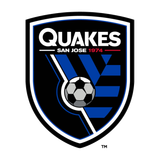
Nickname: The Bay Area is prone to earthquakes, including the famous World Series Earthquake on October 17, 1989. Logo: A triangular shield with "San Jose" at top and "Earthquakes," with a seismograph inside, at bottom. A soccer ball is superimposed over a gray sun inside the shield. Colors: Blue Silver Cream Black |
Played As: San Jose Clash 1996-1999 San Jose Earthquakes 2000-2005 |
Logo 2000-2005 |
First Game Played April 6, 1996 Last Game Payed October 30, 2005 On Hiatus |
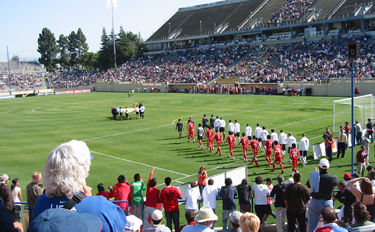
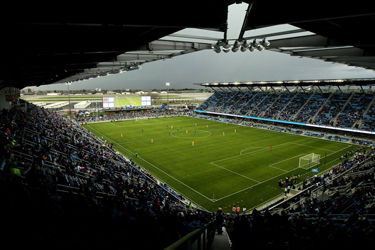
Stadiums: (1) Spartan Stadium 1996-2005 |
MLS Cup MVP: (2) 2001 Dwayne DeRosario F 2003 Landon Donovan M |
Best Season: 2005 (18-4-10; 64 points) Worst Season: 2000 (7-17-8; 29 points) |
Odds and Ends: Mascot: Q |
©MMVI Tank Productions. Stats researched by Stephen Mulvoy, all information, and
team names are property of Major League Soccer. This site is not affiliated with
the San Jose Earthquakes or the MLS. This site is maintained for research
purposes only. All logos used on this page were from Chris Creamer's Sports Logos Page. Page created on July 15, 2004. Last updated on June 1, 2006. at 11:35 pm ET. Home |
Coaches: (6) Laurie Calloway 1996-1997 Brian Quinn 1997-1999 Jorge Espinoza 1999 Lothar Osiander 2000 Frank Yallop 2001-2003 Dominic Kinnear 2004-2005 |
MLS Cup Champions: (1) 2001, 2003 MLS Cup Appearances: (2) 2001, 2003 Supporter's Shield Winner: (1) 2005 Semi-Finals Appearances: (2) 2001, 2003 Conference Champions: (2) 2003, 2005 Playoff Appearances: (6) 1996, 2001, 2002, 2003, 2004, 2005 |
All-Star Games Hosted: (1) 2001 All-Star Game MVP: (1) 2001 Landon Donovan M |
AWARDS Coach of the Year: (2) 2001 Frank Yallop 2005 Dominic Kinnear Rookie of the Year: None Scoring Champion: None Goalkeeper of the Year: (3) 2002 Joe Cannon 2003 Pat Onstad 2005 Pat Onstad Defender of the Year: (1) 1996 John Doyle 2001 Jeff Agoos MVP: None |
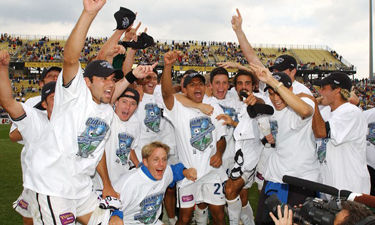
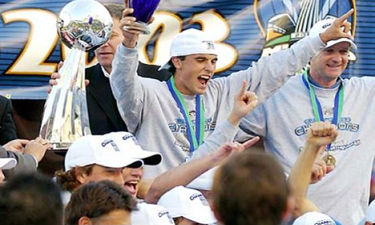
Historical Moments: 1996: On April 6th, 31,683 fans filled into Spartan Stadium to watch the birth of Major League Soccer as the Clash played host to DC United. The game was kept scoreless until the Clash's Eric Wynalda scored late to send the crowd wild and give his team the first ever victory in MLS. San Jose's stars included Wynalda, Dave Salzwedel, Missael Espinoza, and coach Laurie Calloway. The Clash would perform well in their first season, finishing at 15-17 and earning the last playoff spot in the West. The playoffs, though, would be short as they were beaten in three games by their California counterparts, the Los Angeles Galaxy. 1997: The Clash hoped to carry the momentum into their second year, and had big things in mind. But instead of carrying the momentum, there would be a hangover as the Clash fell to the bottom of MLS with a record of 12-20. 1998: Under new coach, Brian Quinn, the Clash would fare no better as they missed the playoffs by four points with a record of 13-19. 1999: Brian Quinn would resign in the middle of the season and was replaced by Jorge Espinoza. Under Espinoza, the Clash would improve a great deal and finish with a solid record of 19-13. Normally, this would be good enough to land a high spot in the playoffs, but with a strong Western Conference, the Clash would not qualify. In the offseason, the team changed their look and identity to "Earthquakes" to make themselves more familiar with the Bay Area. 2000: The Earthquakes would have no spark under new coach Lothar Osiander and finish in dead last in MLS with an embarrassing record of 7-17-8. Osiander would step down and would be replaced by Frank Yallop following the season. 2001: Spurred by the acquisition of Landon Donovan, the Quakes would become a much stronger team. Donovan would steal the show in the All-Star game in San Jose, capturing MVP honors. The Earthquakes would easily make their first playoff appearance in five years with their first winning record of 13-7-6. They could have had a chance to win the West, sitting only two points behind the LA Galaxy. But the September 11 attacks cancelled the final two weeks and the Quakes were seeded 5th. In the playoffs, the Quakes would dispatch the Columbus Crew, 6 points to 0. In the next round, they would hold off a challenge from the Miami Fusion, before Troy Dayak sent the Quakes to MLS Cup for the first time with a series-tiebreaking goal. 2001 MLS Cup: In an all-California match, the Earthquakes faced the Los Angeles Galaxy at Columbus Crew Stadium in the capital of Ohio. The Galaxy would have the upper hand in experience, having been to this game twice before, but the Quakes knew the Galaxy's play well, coming from their division. The team from Southern California grabbed the lead first on a breakaway goal by Mexican star Luis Hernandez in the 21st minute. That seemed to be the killer for the team from Northern California as they had not won a game all season when allowing the first goal. But Landon Donovan was determined to help the Earthquakes snap that trend as he scored a goal from outside the box in the 43rd minute. The game would go scoreless the rest of the way and overtime would be needed to settle the matter. Six minutes into the extra session, San Jose substitute and Canadian International Dwayne DeRosario took a long pass and dribbled between LA's Danny Califf, took a shot that found its way through two LA defenders, 'keeper Kevin Hartman's fingertips, the far post and into the net, and the Quakes won the Cup. DeRosario would be named Cup MVP for the goal. 2002: A surprise championship put a new professional sports team on the Bay Area map as the Earthquakes defended their championship well. Landon Donovan continued to prove he belongs in MLS with another solid season, helping his team to second place in the West with a 14-11-3 record. In the playoffs as the 4th seed, the Quakes would be swept as the Columbus Crew exacted revenge on them for the previous year. 2003: Not fazed by the playoff disappointment, the Earthquakes would roll to another great season. Despite the loss of goalkeeper Joe Cannon, who left to play in Europe, Pat Onstad helped the Quakes to their first regular season conference championship with a solid record of 14-7-9. The playoffs would see the Earthquakes fall behind in their aggregate goal series with the LA Galaxy. By halftime of their second game, the Quakes trailed the game 2-0 and the series 4 goals to 0. But like magic, they scored four unanswered goals and Rodrigo Faria scored a series tiebreaking goal to miraculously propel the Earthquakes to the Western Conference Final against the Kansas City Wizards. In that game, the Quakes fell behind twice, and battled back to force overtime. The Wizards and Earthquakes would then battle deep into the night until Landon Donovan scored a goal in the 117th minute to advance to MLS Cup for the second time in three years. 2003 MLS Cup: At the Home Depot Center in Carson, California, the Earthquakes would battle the Chicago Fire for the right to be Major League Soccer's only other multiple champions, aside from DC United. The match would get off to a fast start as the Quakes' Ronnie Ekelund scored on a free kick in the 5th minute. Landon Donovan would then give his squad insurance in the 38th minute. In the second half, the Fire's DaMarcus Beasley cut the lead in half with a goal in the 49th minute. But a minute later, the Earthquakes' Richard Mulrooney brought his team back to a 2-goal lead. In the 54th minute, the Fire were helped by an own goal by the Quakes' Chris Roner, the first in MLS Cup history. The Fire had a chance to tie the game with a penalty kick, but Pat Onstad would save his team by saving the kick, and in the 71st minute, Donovan put the icing on the cake with his second goal as the Earthquakes claimed their 2nd MLS Cup in three years. Donovan earned MVP honors with his two goals. 2004: Following their 2nd MLS Cup championship, coach Frank Yallop resigned to take the head coaching position for the Canadian National Team. A dark cloud hung over the franchise as the Earthquakes would struggle, winning only four games in the first 3 months, while the club's investor/operator AEG repeatedly threatened to relocate the franchise due to bad attendance and mediocrity. Despite the distractions, the Quakes would go through a strong summer which would help them to a playoff berth. The Quakes entered playoffs unbeaten in the final 7 on the way to a 9-10-11 record. In the aggregate goal series, the Earthquakes would put up a good fight, winning the first game over the Kansas City Wizards, 2-0. But a collapse in the second game saw them lose, 3-0 and the series 3 goals to 2. Following the season, the Quakes would take another hit, losing Landon Donovan to his former club in Germany, Bayer Leverkusen. 2005: With an even darker cloud hanging over the franchise, the Earthquakes were surprised to learn that Landon Donovan decided to move back to MLS, but play for the Galaxy. In addition, the Quakes' front office seemed destined to relocate them with unstable revenues and always low attendance. Despite the of the field distractions, the Earthquakes would go on to put together one of the best seasons in history. After tying three of their first four games, the Earthquakes shook up MLS and dominated the league. They had an unbeaten summer and would also win all but one of their games in September. By season's end, they found themselves on top of the league with a more than solid 18-4-10 record and 64 points. But in the playoffs, their in-state nemesis, the LA Galaxy, outscored them in their two playoff games, 4-2 and rendered their historic season for naught. On December 16, the club announced it was moving to Houston, Texas. But at the same time, MLS committed to an expansion team in San Jose as early as 2007. In much the same fashion of the Cleveland Browns, their name, logo, history and colors will be preserved for the new team. |


Logo 1996-1999 |