Nickname:
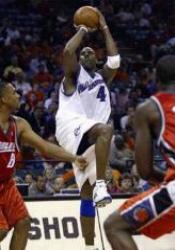
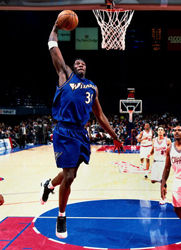
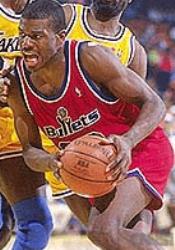
Originally called Bullets because of Baltimore's original NBA team that played in an Armory. In 1996 owner Abe Polan decided to change it due to a number of recent high profile shooting deaths. The name Wizards was chosen over other finalists like Dragon, Express, Seadogs and Stallions in various focus groups.

Logo
:
A Wizard conjuring up a basketball on a half moon that has basketball threads. The white bear cuts his black shirt in a way that forms a W.

Colors
:

Blue
Black
Bronze
 
Coach:
Eddie Jordan 2003/04-

Arena
:
Verizon Center* 1997/98-

*-Known as MCI Center 1997-2005
 
Historical Moments:
1963/64: After 2 nicknames in 2 years in Chicago, the NBA's newest franchise was on the move, heading to Baltimore where they paid tribute to the city's first NBA team named the Bullets, who got their name because they played in an armory. The original Bullets played in the ABL and NBA then called the BAA from 1944 until folding during the 1953/54 season. Along the way the Bullets took home the 2nd Championship in league history in 1948. The new Bullets were quite different they were an up and coming expansion team with the 2 previous Rookie of the Year winners. After 2 last place finished in Chicago the Bullets finally escape last place, but finish far out of the playoffs with a 31-49 record, which lands them in 4th place in the Western Division.

1964/65: Prior to their second season in Baltimore the Bullets pull off a blockbuster trade sending Terry Dischinger, Rod Thorn, and Don Kojis to the Detroit Pistons for Bailey Howell, Don Ohl, Bob Ferry, and Wally Jones. The trade would work out for the Bullets as Howell proved to be a hustling, fundamentally sound player that helped the Bullets get into the playoffs for the first time in franchise history with a 37-43 record good enough for 3rd place. The Bullets especially excelled at home posting a 23-14 record at the Baltimore Civic Center. In the playoffs the Bullets would stun the St. Louis Hawks in 4 games to reach the Western Finals. In the Western Finals the Bullets would split the first 4 games against the Los Angeles Lakers before falling in 6 games.

1965/66
:
Just a few games into the season the Bullets would stun their fans by dealing away their top player Walt Bellamy to the New York Knicks for Jim Barnes, Johnny Green, and Johnny Egan. The Bullets would make up for the loss of Bellamy by using a team approach that saw 6 players led by Don Ohl averaging double digits n scoring as they finished in 2nd place with a 38-42 record. However, in the playoffs the Bullets would make a quick exit as they are swept in 3 straight by the St. Louis Hawks.

1966/67
:
In their 4th season in Baltimore the Bullets are finally moved into the Eastern Division as Chicago receives a new expansion team known as the Bulls. However, the Bullets would never shoot straight as they struggled all year enduring a 13-game losing streak on the way to finishing in last place with a league worst 21-61 record.

1967/68
:
After losing 61 games the Bullets were forced to rebuild through the draft. They took a major first step in that direction by selecting Earl "The Pearl" Monroe with the first overall pick. The Pearl was a flashy player, a deft ball handler, and a creative, unconventional shot maker. He was the first player to make the reverse spin on the dribble a trademark move. In his rookie season he would lead the Bullets in scoring with 24.3 ppg, as the Bullets, winning the Rookie of the Year improved by 15 games posting a 36-46 record. However, they would still finish in last place.

1968/69
:
The Bullets continued to improve through the draft by selecting Center Wes Unseld, a 2-time All-American from Louisville. Unseld would have an immediate impact as he finished 2nd in the NBA in rebounding with 18.2 per game as the Bullets went from worst to first posting a league best 57-25 record, as super rookie Wes Unseld won both the Rookie of the Year and MVP. However, in the playoff the Bullets would suffer a major let down as they are swept in 4 straight games by the New York Knicks.

1969/70:
The Bullets would get started on a strong note as they won 9 straight games in November on the way to a solid record of 50-32. However, in a competitive Eastern Division the Bullets would have to settle for 3rd place. In the playoffs the Bullets were matched up against the New York Knicks for the 2nd straight seasons. After losing the first 2 games on the road the Bullets battled back to win the next 2 at home. After the Knicks captured Game 5 in New York the Bullets forced a 7th game with a solid 96-87 win at the Civic Center. However, the Bullets would fall in Game 7 as the Knicks who would go on to win the NBA Championship won Game 7 at the Garden in a series in which the home team won all 7 games.

1970/71
:
The NBA divides itself into 4 divisions as the Bullets are placed in the Central Division inside the Eastern Conference. Despite playing mediocre basketball all season the Bullets would capture the Central Division with a 42-40 record. In the playoffs the Bullets would get off to a quick start as they grabbed a 3-1 series lead over the Philadelphia 76ers. However, the Bullets would find themselves in a 7th game as the 76ers won 2 close games. Game 7 would also be close, but this time the Bullets would emerge victorious 128-120. Facing the New York Knicks again the Bullets found themselves in a familiar pattern as they lost the first 2 on the road before winning the next 2 at home. However, the Bullets would finally break through in Game 5 by the Knicks at Madison Square Garden 89-84. The Bullets would have a chance to close the series out at home in Gam6, but the Knicks would bounce back with a 113-96 win to force a 7th game in New York. However, this time the Bullets would bounce back, winning in New York again by 2 points to reach the NBA Finals. However, the Bullets would run out of gas in the finals as they are swept in 4 straight games by the Milwaukee Bucks.  

1971/72
:
The Bullets would stun their fans and the entire league by trading Earl "The Pearl" Monroe 3 games into the season to the rival New York Knicks for Dave Stallworth, Mike Riordan, and cash. The Bullets seemed to lose focus without the Pearl posting a 38-44record. However it would still be good enough to win the Central Division. In the playoffs the Bullets would be haunted by the Pearl as they are beaten by the Knicks in 6 games.  

1972/73
:
The Bullets would improve themselves substantially by acquiring Elvin Hayes from the Houston Rockets and drafting Kevin Porter. After a slow start the Bullets began to come make their charge in December posting a 10-4 record on the way to capturing the Central Division for the 3rd straight season with a 52-30 record. However, in the playoffs eth Bullets would bye undone by the New York Knicks again losing the first 3 games before falling in 5 games. Following the season the Bullets would move to Landover a suburb of Washington DC. Though no longer playing Baltimore the Bullets would continue to be vital part of the Baltimore community playing occasional games at the Civic Center over the next 20 years.

1973/74:
Playing in the Washington suburb of Landover the Baltimore Bullets become the Capital Bullets, as they won the Central Division again with a 47-35 record despite seeing Wes Unseld limited to 56 games due to injuries. In the playoffs the Bullets would be beaten by the New York Knicks for the 5th time in 6 years losing a tough hard fought series in 7 games. 

1974/75:
Now named the Washington Bullets, the team captures its 6th division title in 7 years by posting a franchise best record of 60-22. The Bullets were nearly unbeatable at home posting a record of 36-5 at the Capital Centre. In the playoffs the Bullets would survive a tough 7-game series against the Buffalo Braves as the home team took all 7 game in a series in which the teams alternated home games. In the Eastern Finals the Bullets got off to a quick start jumping out to a 3-1 series lead before beating the Boston Celtics in 6 games to reach the NBA Finals for the 2nd time in franchisee history. However once against the Bullets are swept in 4 straight this time by the Golden State Warriors who win 2 of the 4 games by 1 point.

1975/76
:
After being swept in the Finals the Bullets lose their grip on the Central Division missing out on their 6th straight division title by 1 game with a record of 48-34. In the playoffs the Bullets would again defend their home territory winning all 3 games at the Capital Centre. However, they would lose all 4 games on the road to the Cleveland Cavaliers as they lost in 7 games. Following the season Coach K.C. Jones would be forced despite a solid 63% winning percentage.

1976/77
:
Under new Coach the Bullets would again fall short of the Central Division Title by 1 game with a record of 48-34 as Elvin Hayes finished 6th in the league in rebounds with 12.5 per game. In the first round the Bullets would beat the Cleveland Cavaliers in a 3-game series. In the 2nd round the Bullets would get off to a good start taking 2 of the first 3 games against the Houston Rockets. However, with a chance to take a 3-1 lead at home the Bullets would lose 107-103 as the Rockets went on to take the final 3 games to take the series in 6 games.  

1977/78
:
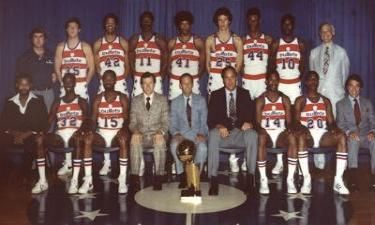
After a slow start in which they lost 6 of their first 10 games the Bullets played stead basketball until January 13th when they beat the defending Champion Portland Trailblazers to improve to 24-15. However, injuries would begin to have an effect on the team as the Bullets struggled losing 13 of their next 18 games. Hovering around .500 the rest of the way, the Bullets would need as strong finish just to slip into the playoffs with a 44-38 record. However as the playoffs began the Bullets began to get healthy and started to play solid basketball they would get off to a quick start by sweeping the Atlanta Hawks in 2 straight. Moving on to the 2nd round the Bullets continued to play solid basketball as they jumped out to a 3-1 series lead before stunning the Central Division Champion San Antonio Spurs in 6 games, capped by a Game 6 of strange circumstances at the Capital Centre. The game started out oddly as Spurs guard Mike Gale was forced to a wear an inside out Bullets uniform after losing his uniform at the airport. In the 3rd period the Spurs would make a run and take a 62-61 lead when the lights went out at the Cap Centre. When the lights came back on the Bullets would come out shooting on the way to a 103-100 win. In the Eastern Finals the Bullets again would get out to a fast start taking a 3-1 series lead against the Philadelphia 76ers. After losing Game 5 on the road the Bullets had a chance to close the series at home. In the closing seconds Wes Unseld would rebound a shot of his own miss to give the Bullets a dramatic 101-99 victory. After being swept in their previous 2 trips to the NBA Finals the Bullets got off to a shaky start losing Game 1 on the road against the Seattle Supersonics, blowing a 19-point lead. After rebounding to win Game 2 at home the Bullets appeared to be in trouble losing Game 3 at home, and needing a road win to avoid falling behind 3-1 in the series. However, the Bullets would rise to the occasion beating the Sonics 120-116 to even the series at 2 games apiece. After losing Game 5 in Seattle the Bullets kept their hopes alive with a dominating 117-82 win at the Cap Centre. In Game 7 in Seattle the Bullets were a heavy underdog as Kevin Grevey suffering a sprained wrist above his shooting hand, Bob Dandridge was forced to see some action at guard.  However Dandridge would play strongly scoring 19 points to tie with Charles Johnson for the team high, as Wes Unsled scored 15 points while pulling down 9 boards as the Bullets emerged with a 101-94 victory to win their first NBA Championship.   

1978/79
:
Coming off their NBA Championship the Bullets are shifted to the Atlantic Division. However, they would continue to remain one of the top teams in the league as they capture the division championship with a league best record of 54-28. Despite their stellar record the Bullets would not end the season on a strong note losing 8 of their last 11 as they entered the playoffs. After a first round by the struggling Bullets needed 7 games to beat the Atlanta Hawks nearly blowing a 3-1 series lead. In the Eastern Finals the Bullets would themselves down 3 games to 1 facing the San Antonio Spurs. However the Bullets would rally to win the next 2 games and force a 7th game at home. In Game 7 the Bullets would rally again overcoming a 4th Quarter deficit to beat the Spurs 107-105 to set up a rematch with the Seattle Supersonics in the NBA Finals. IN the Finals the Bullets would squeak out a close victory in Game 1 99-967. However, the Sonics would rally to win the next 4 and take the series in 5 games ending the Bullets Championship reign.

1979/80
:
Coming off back to back NBA Finals appearances the Bullets began to show signs of age as they struggled all season and barley made into the playoffs they captured the 6th and final playoff spot with a tiebreaker despite a disappointing 39-43 record. In the playoffs the Bullets fall would be completed as they are beaten by the Philadelphia 7ers in 2 straight games.

1980/81
:
The aging Bullets continued to struggle as they posted a 39-43 record for the second year in a row. However, this time the Bullets would not be able to get back into the playoffs as a string of 12 straight postseason appearances came to an end. The season would also mark the end of an era as Wes Unseld retires and Elvin Hayes is traded to the Houston Rockets to finish his career with the team he started with, and the city where he stared in college.  

1981/82
:
To replace Wes Unseld and Elvin Hayes the Bullets acquired bruising overachievers like Greg Ballard, who led the club in scoring with 18.8 ppg, and Jeff Ruland, who topped the team in rebounds with 9.3 pre game, as the Bullets overcame a 9-15 start to make it back into the playoffs with a record of 43-39. In the playoffs the Bullets would make it past the first round by sweeping the New Jersey Nets in 2 straight. However, in the 2nd round they would be overmatched by the Boston Celtics as they were beaten in 5 games.

1982/83: The Bullets continued to make the best with the talent they had posting a 42-40 record. However, this time they would not be able to slip into the playoffs as they finished in last place in a highly competitive Atlantic Division.

1983/84
:
The Bullets continue to struggle as they finished last in the Atlantic Division with a record of 35-47. However, with the NBA expanding the playoffs to 8 teams in each conference the Bullets were able to qualify as one of the top 8 teams. I the playoffs it would be a quick exit as the Bullets are beaten by the Boston Celtics in 4 games. 

1984/85: The Bullets continued to play mediocre basketball as they finished in 4th place with a 40-42 record despite losing Jeff Ruland for half a season to a back injury. In the layoffs it would be a replay of the previous season as the Bullets are overmatched by the Philadelphia 76ers in 4 games.

1985/86
:
In the draft the Bullets went international by selecting 7'7" Manute Bol a Dinka tribesman from Sudan, who was one of the most unique players in NBA history. Pipe cleaner thin at 225 pounds, he filled only one role-that of designated shot blocker. With Bol blocking a league best 397 shots the Bullets finished in 3rd place with a record of 39-43. In the playoffs it would be another first round exit as the Bullets are beaten by the Philadelphia 76ers in a 5-game series.

1986/87
:
Looking to jump-start their fortunes the Bullets acquire Moses Malone for the Philadelphia 76ers for Jeff Ruland. Moses Malone would lead the team in scoring with 24-1 ppg as he would be joined by Jeff Malone who averages 22.0. However, the improvement is minimal as the Bullets finished in 3rd place with a 42-40 record. However, once again it would be a quick exit in the playoffs as the Bullets are swept by the Detroit Pistons in 3 straight games. 

1987/88
:
To balance Manute Bol who at 7'7" was the tallest player in NBA history the Bullets draft Muggsy Bogues who at 5'3" is the smallest player in NBA history. The Bullets would get off to a slow start as Coach Kevin Loughery is fired 27 games into the season with Bullets holding an 8-19 record. To replace Loughery the Bullets hired former MVP Wes Unseld. Under Unseld the Bullets played much better as they were able to sneak into the playoffs again with a record of 38-44. After losing the first 2 games on the road in the playoffs to the Detroit Pistons the Bullets fought back and forced a 5th game with 2 home wins. However, back in Detroit for Game 5 the Bullets are beaten by 21 points as they suffer another first round exit.

1988/89
:
The Bullets show slight improvement posting a 40-42 record. However, they would miss the playoffs for the first time in 5 years as they finished 2 games out of the final playoff spot while finishing in 4th place. 

1989/90
:
After a 5-1 start the Bullets hopes of a good season fades quickly as they lose 16 of 18 games form mid December to mid January. The Bullets would go on to finish in 4th place with a poor 31-51 record despite stellar season from Jeff Malone and Bernard King who average 24.3 and 22.3 ppg respectively, to lead the team.

1990/91
:
Bernard King provides a great story as he comes all the way back from knee surgery he suffered while playing for the New York Knicks in 1985 to finish 3rd in the league in scoring with 28.4 ppg highlighted by two 50 point performances. However with a 9-game losing streak in February the Bullets struggles would continue as they finished in 4th place with a record of 30-52.

1991/92
:
The Bullets endured prolonged losing streaks in almost every month losing 8 straight in December and January, 7 in March and 6 straight in February, and April on the way to finishing in 6th place with a miserable record 25-57. Pervis Ellison who the Bullets acquired from the Sacramento Kings a year earlier would provide the lone bright spot winning Most Improved honors by leading the team in rebounds and scoring.

1992/93
:
A year after being named Most Improved Player Pervis Ellison who had a history of injuries plays only 49 games as the Bullets struggles continue as they fall into last place with an awful record of 22-60. Providing the only bright spot is Tom Gugliotta who makes the All-Rookie team by averaging 14.7 points and 9.6 rebounds per game.

1993/94: Injuries continue to bite the Bullets as key players Rex Chapman, Calbert Cheaney the club's first round draft pick miss significant stretches and Pervis Ellison miss almost the entire season. The banged up Bullets would go on to finish in last place again with a record of 24-58. 

1994/95
:
The Bullets who drafted Juwan Howard in the first round make a big splash by acquiring his former "Fab Five" team mate at Michigan Chris Weber, who had forced a trade from the Golden State Warriors after winning the Rookie of the Year. To get Webber the Bullets sent the Warriors Tom Gugliotta and 3 future first-round draft picks. Webber would make an instant impact scoring double digits in every game. However he would suffer a separated shoulder in December that sidelined him for 19 games ending any hopes the Bullets had for making the playoffs. When Webber returned he was still clearly showing the effect of the injury as the Bullets finished in last place again with a 21-61 record.

1995/96: In his 2nd season Juwan Howard would emerge as a star on the court and in the community averaging a team high 22.1 ppg. However his teammate Chris Webber would be limited to 15 games following the lingering effect to his injured shoulder. However players like Gheorghe Muresan who was named Most Improved Player would pick up the slack averaging 14.5 ppg, 9.6 rpg and 2.26 bpg. However the Bullets would fall 3 games short of a return to the playoffs as they finished in 4th place with a 369-43 record, which was an impressive 18 game improvement over the previous season.

1996/97:
Despite a healthy Chris Webber the Bullets would play mediocre basketball for most of the first half producing a record of 22-24 when Coach Jim Lyman is replaced by Bernie Bickerstaff.  Under Bickerstaff the Bullets would finish the season on a string note winning 16 of their final 21 games to slip into the playoffs with a record of 44-38 ending an 8-year playoff drought. In the playoffs the Bullets would be overmatched by the Chicago Bulls who were well on the way to their 2nd straight NBA Championship losing 3 straight games. However, the Bullets would make it respectable as they lost all 3 games by a total of 18 points.

1997/98
:
A year after making the playoffs for the first time in 8 years their was a new beginning for basketball in Washington as the team changed its name to Wizards fearing Bullets endorsed gun violence. The change came complete with a new logo and new uniforms and a new arena as the MCI Center in downtown Washington opened on December 2nd with the Wizards beating the Seattle Supersonics 95-78. At the MCI Center the Wiz were hard to beat as they posted a 24-12 record while setting a team record in attendance. However the Wizards would fall 1 game short of the playoffs as they finished in 4th place with a 42-40 record.

1998/99:
Prior to the start of the season which was delayed by a 4-month lockout the Wizards would trade Chris Webber to the Sacramento Kings for Mitch Richmond and Otis Thorpe. Richmond would have a solid season finishing 2nd in the league with 9.9 assists per game. However the Wizards would continue to under achieve as they finished in 6th place with a disappointing record of 18-32.  

1999/00
:
The Wizards continue to underachieve finishing in last place with a dreadful record of 29-53 as the team went through 2 coaches for the 2nd straight season. However, the biggest news would involve the front office as Michael Jordan the best player in NBA history joins the team as Vice President. Following the season Jordan would begin to influence personal decisions as Leonard Hamilton was hired as head coach.

2000/01
:
Under new Coach Leonard Hamilton the Wizards continued to struggle as people scoffed that their best player was sitting up in the owner's box. During the season in which they finished in last place again with a dreadful record of 19-63, Juwan Howard, who grown disgruntled with all the team failures is traded to the Dallas Mavericks along with Obinna Ekezie and Calvin Booth for Hubert Davis, Alexander, Christian Laettner, Loy Vaught and Etan Thomas.

2001/02: Three years after ending his Chicago Bulls career with a NBA Championship clinching shot against the Utah Jazz, Michael Jordan comes out of retirement to help the young Wizards learn how to win. Among the young players Jordan was around to tutor was number 1 overall pick Kwame Brown who was drafted out of high school, as Doug Collins who had coached Jordan once before is brought in to lead the team from the bench. Just the presence of Jordan, who donated his entire salary to relief efforts after the September 11th terrorist attacks on New York and the Pentagon, was enough to sellout the MCI Center for all 41 games. Michael Jordan would show flashes of brilliance scoring 51 points on December 29th against the Charlotte Hornets and hitting several game winning shots. However, Jordan would only play half the season as a knee injury sidelined him for most of the 2nd half. Nonetheless his presence had a positive effect as the Wizards made an 18-game improvement finishing in 5th place with a 37-45 record that saw them miss the playoff by just 5 games.

2002/03
:
The Wizards would continue to make changes as Richard Hamilton is traded to the Detroit Pistons for Jerry Stackhouse, who also starred at UNC is brought in to be the "air apparent" to Michael Jordan who announced it would be his final season. Once again Jordan would be the story as he went on the farewell tour again showing flashes of brilliance, as he became the first player to score 40 points in a game after his 40th birthday. However, the young players like Stackhouse and Kwame Brown grew tired of Jordan's criticism that they did not hustle. This was no more apparent in Jordan final game in New York when he dove on the court for loose balls while Brown just stood around and watched. The Wiz would be in the race for the final playoffs spot until the final weeks of the season when they ended the season by losing 7 of their last 10 games to finish in 5th place with a 37-45 record falling 5 games short of the playoffs again. Michael Jordan's final game would end up being on April 16th as he scored 15 points against the 76ers in Philadelphia. The final point of Jordan's career would come for the free throw line, as the crowd in Philadelphia gave him a standing ovation.

2003/04:
Under new Coach Eddie Jordan the Wizards showed signs early as they won their first game against the Chicago Bulls 99-74, and held the Toronto Raptors to 60 points while winning 3 of their first 5 games. However, talent wise the Wizards had a tough time most nights staying in the game as they struggled their way to a 25-57 record while finishing in last place in the Atlantic Division. Although there still were a few bright spots to build off as Kwame Brown began to show promise that made him the number 1 pick in 2001, while Jarvis Hayes was on the NBA All-Rookie 2nd team.

2004/05
:
The Wizards got off to a decent start and stood above .500 after the first 2 months of the season. When January rolled around they would catch fire winning 11 of their first 13 games in the New Year, to establish a nice lead for a playoff spot, which they would hold all season ending an 8-year playoff drought going 45-37, good enough for 2nd place in the Southeast Division. Leading the way for the Wizards turn around was Gilbert Arenas who had a break out year averaging 25.5 ppg, while Larry Hughes averaged 22 and Antawan Jamison averaged 19.6 ppg. In the playoffs the Wizards faced the Chicago Bulls dropping the first 2 games on the road. As the series shifted to Washington the Wizards recovered winning both at the MCI Center to even the series. In Game 5 the Wizards went back to Chicago and pulled out a miracle after watching a  22-point lead wilt away, Gilbert Arenas saved the day with a game winning 14-footer at the buzzer for a dramatic 112-110 win. Back in Washington for Game 6 the Wizards edged the Bulls 94-91 to sew up their first playoff series victory in 23 years. The Wizards were so elated they even done shirts to celebrate their victory. However the joy would be short lived as they would be swept in the 2nd Round by the Miami Heat in 4 straight.

2005/06
:
Despite the loss of Larry Hughes to Free Agency the Wizards got off to a strong start winning five of their first six games. However it would quickly be wiped out as the Wizards lost their next five games and 13 of their next 17 games. The Wizard would finally find their game again in January where they posted a 9-6 mark and regained the .500 mark. The Wizards would hover around the .500 mark the rest of the season as Gilbert Arenas continued to blossom into a NBA superstar with a team high 29.3 ppg. The Wizards would end up finishing the season as the 5th seed in the Eastern Conference with a 42-40 record. Facing the Cleveland Cavaliers in the playoffs the Wizards would earn a split on the road in the first two games, earning them a chance to take control of the series as it shifted to Washington. Up by 1 point the Wizards would suffer a crushing defeat in Game 3 as LeBron James hit a game winning shot with 5.7 seconds left to give the Cavs a 97-96 win. The Wizards would quickly rebound to even the series again with a 106-96 win in Game 4. In Game 5 the Wizards would make a furious comeback scoring seven points in the final 78 seconds capped by a Caron Butler lay-up to force overtime tied at 107-107. However, LeBron broke the Wizards hearts again with a basket with 0.9 seconds left to give the Cavaliers a 121-120 win in OT. Game 6 back at the Verizon Center would also see overtime frustration for the Wizards as Gilbert Arenas missed two key free throws while being taunted by LeBron James, as the Cavaliers won the series with a 114-113 win.

2006/07:
After the bitter ending the Wizards entered the season with renewed optimism as they signed free agent DeShawn Stevenson, with the hopes of taking the next step. However, when the season started the Wizards were a little shaky, losing 9 of their first 13 games. In December the Wizards would turn things around as they won five straight and climbed over .500, highlighted by a 60-point games from Gilbert Arenas in a thrilling 147-141 overtime win over the Los Angeles Lakers on the road December 17th. Along the way the Wizards also played the role of streak busters ending the Dallas Mavericks 12-game winning streak, with a 106-97 win on December 4th, and then ending a 15-game winning streak by the Phoenix Suns with a 144-139 overtime win on the road 18 days later. In January the Wizards took over the division lead as their strong play continued. However, as the month came to a close the injury big began to rear its ugly head as Antwan Jamison was lost with a sprained knee, in his absence the Wizards would struggle losing 8 of their next 12 games. Down the stretch the injuries swept through the Wizards roster like a hurricane, as Caron Butler and Gilbert Arenas, the two leading scorers were both lost at the start of April. With 42.3% of their offensive production sidelined lost eight of nine as they limped into the playoffs with a record of 41-41. In the playoffs the banged up Wizards would offer little resistance to the Cleveland Cavaliers who won their first round series in four straight games.
Logo
1997-Present
45th Season
First Game Played October 16, 1963


Address:
601 F Street NW
Washington, D.C., 20004
Phone: (202) 661-5000

Web:
http://www.washingtonwizards.com


Coaches: (20)
Bob Leonard  1963/64
Buddy Jeannette 1964/65
Paul Seymour 1965/66
Mike Farmer 1966/67
Buddy Jeannette 1966/67
Gene Shue 1966/67-1972/73
K.C. Jones 1973/74-1975/76
Dick Motta 1976/77-1979/80
Gene Shue 1980/81-1985/86
Kevin Loughery 1985/86-1987/88
Wes Unseld 1987/88-1993/94
Jim Lynam 1994/95-1996/97
Bob Staak 1996/97
Bernie Bickerstaff 1996/97-1998/99
Jim Brovelli 1998/99
Gar Heard 1999/00
Darrell Walker 1999/00
Leonard Hamilton 2000/01
Doug Collins 2001/02-2002/03
Eddie Jordan 2003/04-Present


Arenas: (3)
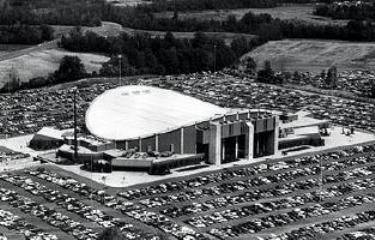
Baltimore Civic Center 1963-1973
Capital Centre* 1973/74-1997/98
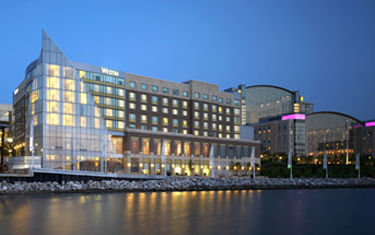
Verizon Center** 1997/98-Present
*-Known as US Air Arena 1993/94-1997/98
**-Known as MCI Center 1997-2005
 
NBA Champions: (1)
1978

NBA Finals
: (4)
1971, 1975, 1978, 1979

Conference Finals
: (5)
1965, 1971, 1975, 1978, 1979

Division Champions
: (7)
1969, 1971, 1972, 1973, 1974, 1975, 1979

Playoff Appearences
: (27)
1965, 1966, 1967, 1968, 1969, 1970, 1971, 1972, 1973, 1974, 1975, 1976, 1977, 1978, 1979, 1980, 1982, 1984, 1985, 1986, 1987, 1988, 1997, 2005, 2006, 2007, 2008
 
 
Hall of Famers:(7)
Walt Bellamy C 1963/64-1965/66
Dave Bing G 1975/76-1976/77
Elvin Hayes F 1972/73-1980/81
Bailey Howell F 1964/65-1965/66
Moses Malone C 1986/87-1987/88
Earl Monroe G 1967/68-1971/72
Wes Unseld C 1968/69-1980/81


Retired Numbers: (4)
10 Earl Monroe G 1967/68-1971/72
11 Elvin Hayes F 1972/73-1980/81
25 Gus Johnson F 1963/64-1971/72
41 Wes Unseld C 1968/69-1980/81
 
 
NBA All-Star Games Hosted: (3)
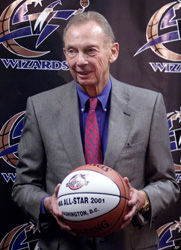
1969, 1980, 2001

NBA All-Star Game MVP
:

None
 
 
AWARDS
Coach of the Year: (2)
1969 Gene Shue
1982 Gene Shue


Most Improved Player
: (3)
1992 Pervis Elision G
1994 Don MacLean C
1996 Gheorghe Muresan C

Rookie of the Year: (2)
1968 Earl "The Pearl" Monroe G
1969 Wes Unseld C

6th Man Award
:
None

Defensive Player of the Year
:
None

NBA MVP
: (1)
1969 Wes Unseld C


NBA Finals MVP: (1)
1978 Wes Unseld C
 
 
Best Season:
1974/75 (60-22)

Worst Season
:
2000/01 (19-63)
 
 
Odds and Ends:
Cheerleaders:
Wizards Dancers

Mascot:
G-Wiz and G-Man


On the Air:
Television:
WBDC (Channel 50); Comcast Sports Network

Radio:
WTEM (980 AM)

Broadcasters:

Steve Buckhantz and Phil Chenier-TV; Glenn Consor and Dave Johnson-Radio
 
 
Alternate Logo
1997-Present
©MMVIII Tank Productions. Stats researched by Frank Fleming, all information, and team names are property of the National Basketball Association.  This site is not affiliated with the Washington Wizards of the NBA.  This site is maintained for research purposes only.  All logos used on this page were from Chris Creamer's Sports Logos Page.
Page created on April 27, 2003.  Last updated on April 22, 2008 at 12:00 am ET.  
Home
Played As:
Chicago Packers
1961/62

Chicago Zephyrs
1962/63


Baltimore Bullets
1963/64-1972/73

Capital Bullets
1973/74

Washington Bullets
1974/75-1996/97


Washington Wizards 1997/98-Present