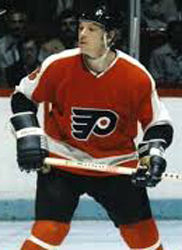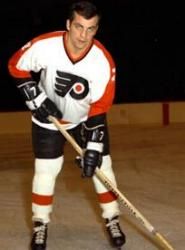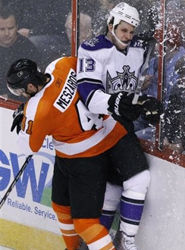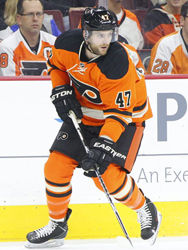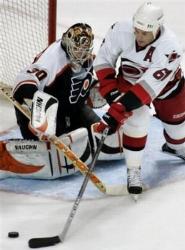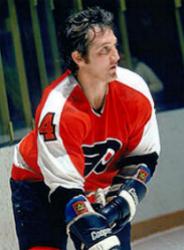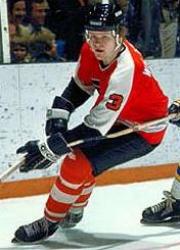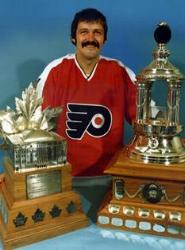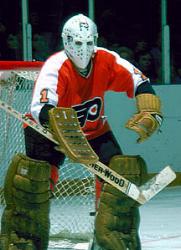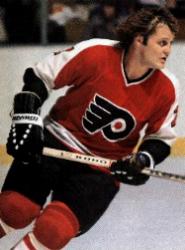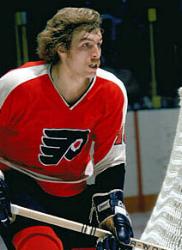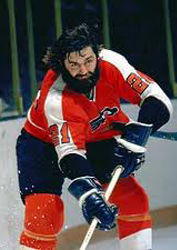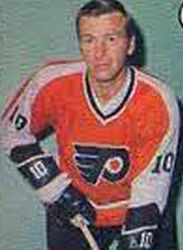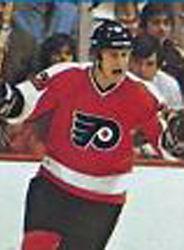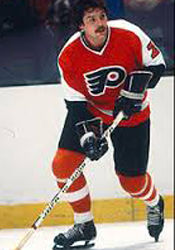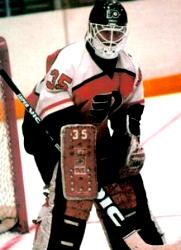
Nickname: After 25,000 entries, a committee chose Flyers, although the winning entry was spelled Fliers, because it went well phonetically with Philadelphia. Colors: Orange Black White |
Coach: Peter Laviolette 2009/10- Arena: Wachovia Center* 1996/97- *-Known as Corestates Center 1996-1998 & First Union Center 1998-2003 |
Historical Moments: 1967/68: Nearly 40 years after the Quakers were forced to fold after just 1 season in Philadelphia the NHL returned to the "City of Brotherly Love" as the Flyers are one of 6 expansion teams the NHL adds to double the league to 12 teams. The Flyers would make their debut on October 11th losing to the California Seals on the road 5-1. A week later they would get their first win beating the St. Louis Blues on the road 2-1. On October 19th the Flyers would finally make their home debut as they shutout the Pittsburgh Penguins 1-0 at The Spectrum. The Flyers would go on to complete their inaugural season by finishing atop the all expansion Western Division with a 31-32-11 record. However, down the stretch of the season the Flyers were forced to play on the road after a winter storm blew off part of the roof at The Spectrum. Playing their home playoff games in Quebec City the Flyers would miss their home ice advantage as they are beaten by the St. Louis Blues in 7 games. 1968/69: In their second season the Flyers would struggle through out the season as they return to The Spectrum, after being forced to finish their first season on the road. Led by Andre Lacroix who leads the team with 24 goals, the Flyers would make the playoffs again despite an awful 20-35-21 record. In the playoffs the Flyers would fizzle right away as they are swept in 4 straight by the St. Louis Blues. 1969/70: Bobby Clarke has an impressive first season scoring 15 goals with 31 assists while making it to the All-Star Game. However, the Flyers would struggle all season missing the playoffs by finishing in 5th place with a terrible record of 17-35-24. 1970/71: Bobby Clarke continues to establish himself as one of the emerging stars in the NHL as he leads the Flyers in scoring with 63 points. The Flyers would make it back into the playoffs by finishing in 3rd place with a record of 28-33-17. However, the Flyers would be swept out of the first round again losing 4 straight to the Chicago Black Hawks. 1971/72: Under new Coach Fred Shero the Flyers would take a step backward as they missed the playoffs for the 2nd time in 3 years by finishing in 5th place with a 26-38-14 record that had them lose out on the last playoff spot via tiebreaker against the Pittsburgh Penguins. 1972/73: Bobby Clarke captures the Hart Trophy by finishing second in the league in scoring with 104 points as the Flyers post their first winning season by finishing in 2nd place with a record of 37-30-11. After splitting the first 4 games in the playoffs against the Minnesota North Stars the Flyers took a big step toward winning their first playoff series by taking Game 5 in overtime 3-2 on a goal by Gary Dornhoefer. The Flyers would go on to take the series in 6 games with a 4-1 win in Minnesota to close out the series. However, in the semifinals the Flyers would be overmatched by the eventual Stanley Cup Champion Montreal Canadiens losing in 5 games. 1973/74: Led by Dave Schultz's 348 penalty minutes the Flyers earn the reputation as a brawling team known as "The Broad Street Bullies" as they fight and claw their way to the top of the Western Division with a solid record of 50-16-12. Along the Bernie Parent establishes himself the top goalie in the NHL taking home the Vezina with an impressive 1.89 GAA. In the playoffs the Flyers got off to a fast start as they swept the Atlanta Flames in 4 straight games to reach the semifinals for the second straight season. In the semifinals the Flyers would knock off the New York Rangers in a hard fought 7-game series in which the home team won all 7 games. The Flyers secret weapon at the Spectrum may have been Kate Smith whose version of "God Bless America" played occasionally in lieu of "The Starr Spangled Banner" usually meant a Flyers win. After splitting the first 2 games of the Stanley Cup Finals against the Boston Bruins on the road, the Flyers returned home to a rousing ovation at the Spectrum and continued their home ice magic beating the Burins in Games 3 and 4 to take a 3-1 series lead. However, the Bruins would get back into the series by winning 5-1 in Boston. Needing a little more magic to close out the series the Flyers brought Kate Smith to sing "God Bless America" live fans roared through out as the amazing unbeaten streak of home wins when Kate Smith sings continues as the Flyers edge out a 1-0 victory to claim their first ever Stanley Cup Championship. Bernie Parent who blanked the Bruins in Game 6 would go on to win the Conn Smythe award for playoff MVP. 1974/75: The Flyers continue to bully their way through the NHL as they win the newly established Patrick Division with a NHL best record of 51-18-11, as Dave Schultz spends 472 minutes in the penalty box leaving a bunch of broken and bruised bodies in his wake. After a first round bye the Flyers would make it to the semifinals for the 3rd straight season by sweeping the Toronto Maple Leafs in 4 straight games. The Flyers appeared to be heading for another easy sweep as they took the first 3 games against the New York Islanders, with Bernie Parent shutting out the Isles in Games 2 and 3. However, the Islanders would keep their hopes alive with an overtime win in Game 4, and then they proceeded to take the next 2 to force a 7th game. With the Stanley Cup slipping away the Flyers called on Kate Smith again and she came through singing her heart out as the Flyers advanced to the Finals with a 4-1 win. In the Finals the Flyers would get off to a quick start taking the first 2 games against the Buffalo Sabres at the Spectrum. However, the Sabres would battle back to even the series at 2 games a piece with 2 straight wins in Buffalo. Back at the Spectrum the Flyers ceased control of the series with a dominating 5-1 win. In Game 6 in Buffalo it would be Bernie Parent who would close the deal by setting a record with his 5th playoff shutout to earn his second straight Conn Smythe as the Flyers won their second straight Stanley Cup Championship 2-0. 1975/76: The Flyers continue to fight and crawl their way through the NHL as they won their 3rd straight Division title with a solid 51-13-16 record, as Bobby Clarke captured the Hart Trophy for the 3rd time in 4 years with a NHL best 89 assists. However, the highlight of the season came in an exhibition game against the Soviet Red Army Team on January 11th. The Red Army team was one of two Russian teams barnstorming the NHL were unbeaten going into to Philadelphia, as the 2 Russian teams had a combined record of 5-1-1 record against the NHL. Early on it was apparent it was not going to be the Soviet's day as The Spectrum fired up by another rousing rendition of "God Bless America" by Kate Smith had fans chatting USA, as the Flyers bruising style had the Russians whining form the start after just 11 minutes Russia's Coach Konstantin Loktev pulled his team off the ice reacting to an elbowing penalty by Flyers Ed Van Impe to Central Red Army Star Valeri Kharlamov. After 16 minutes the Russian would return to the ice for more abuse as the Flyers won 4-1. Following the game the Soviet state paper "Pravda" would run a cartoon showing the Flyers bearing clubs like cavemen. Seeking their 3rd straight Stanley Cup the Flyers need 7 games to get past the Toronto Maple Leafs to advance to their 4th straight semifinal. With Reggie Leach becoming a goal scoring machine the Flyers would make it back to the Stanley Cup Finals by beating the Boston Bruins in 5 games, as Leach scored 5 goals in the series clinching game. However, not even the scoring of Leach who set a NHL record with 19 goals to capture the Conn Smythe would help the Flyers who were swept in 4 straight games by the Montreal Canadiens. 1976/77: The Flyers would continue to dominate the Patrick Division winning their 5th straight division title with a solid record of 48-16-16. In the playoffs the Flyers would land in the semifinals again as they buried the Toronto Maple Leafs in 6 games. However, in the semis the Flyers would be swept in 4 straight games by the Boston Bruins as they dropped the first 2 games at The Spectrum in overtime. 1977/78: On December 11th Tom Bladon sets an NHL record for a defenseman with 8 points notching 4 goals and 4 assists against the Cleveland Barons. However, the Flyers would lose their grip on the Patrick Division after they have to settle for 2nd place despite another stellar record of 45-20-15. Forced to play in the preliminary round the Flyers would knock of the Colorado Rockies in 2 straight games. Moving on to the second round the Flyers would knock off the Buffalo Sabres in 5 games to make it back into the semifinals for the 6th straight year. However, once again the Flyers would be clipped by the Boston Bruins as they fall in 5 games. Following the season Coach Fred Shero would stun the Flyers by taking the Coaching job with the New York Rangers. However, the Flyers would receive the Rangers first round draft pick, as compensation. 1978/79: After starting the season slowly under new Coach Bob McCammon the Flyers decide to chance coaches in the middle of the season hiring Pat Quinn. Under Quinn the Flyers would finish the season on a strong note finishing in 2nd place with a record of 40-42-15. In the playoffs the Flyers would survive a first round scare as they dropped Game 1 of their preliminary round series against the Vancouver Canucks at home 3-2. However, the Flyers would rally to win the next 2 scoring 13 goals as they advanced to the 2nd record. However, in the second round the Flyers would be knocked off by the New York Rangers led by Coach Fred Shero in 5 games. 1979/80: Powered by a NHL record 35-game unbeaten streak the Flyers climb back to the top of the Patrick Division posting a NHL best 48-12-20 record, as Reggie Leach leads the team with 50 goals and Ken Linesman the player drafted with the compensation pick obtained for Coach Fred Shero adds a team high 57 assists. In the playoffs the Flyers would slip past the Edmonton Oilers in 3 straight games, although they needed overtime in 2 of the 3 games. In the 2nd round the Flyers would jump out to a 3-0 lead before beating the Shero coached New York Rangers in 5 games. The Flyers resurgence would continue in the semifinals as they beat the Minnesota North Stars in 5 games. In the Stanley Cup Finals against the New York Islanders the Flyers would get off to a rough start as they dropped Game 1 at The Spectrum in overtime 4-3, as the Islanders raced out to a 3-1 series lead. However, the Flyers would bounce back to take Game 5 at home 6-3. Trailing 4-2 in the 3rd period of Game 6 the Flyers would rally again to force overtime. However, the Flyers would fall in overtime on a goal by Bob Nystrom, as the, Islanders won their first Stanley Cup. 1980/81: After their heartbreaking loss in the Stanley Cup Finals the Flyers responded with another strong season finishing 2nd in the Patrick Division with a solid record of 41-24-15. In the playoffs the Flyers would get off to a strong start taking the first 2 games at home against the Quebec Nordiques. However, they would need a 5-2 win at the Spectrum in Game 5 to advance to the second round. In the 2nd round the Flyers would struggle as they fell behind the Calgary Flames 3 games to 1. However, the Flyers would respond with a rousing 9-4 in Game 5 to keep their hopes alive. The Flyers would continue their comeback by winning Game 6 in Calgary 3-2. However, back in Philly for Game 7 the Flyers ran out of gas and were scorched by the Flames 4-1. 1981/82: Despite strong seasons from Ken Linesman, Brian Propp and Bill Barber the Flyers would struggle as Coach Dan Quinn is fired and replaced by Bob McCammon. Under McCammon the Flyers would finish in 3rd place with a 38-31-11 record. In the playoffs the Flyers would be upended by the New York Rangers in 4 games failing to make at least the second round of the playoffs for the first time in 9 years. 1982/83: Led by aging veterans Bobby Clarke and Darryl Sittler the Flyers would reclaim the top spot in the Patrick Division beating out the New York Islanders by 10 points with an impressive record of 49-23-8. However, in the playoffs the Flyers would experience a major let down as they are swept by the New York Rangers in 3 straight allowing a total of 18 goals in 3 games. 1983/84: The Flyers continued to be one of the strongest teams in the NHL as new blood began to take over with Tim Kerr leading the way with a team high 93 points as the Flyers finished in 3rd place with a record of 44-26-10. However, once again the Flyers would experience a playoff let down as they are swept in 3 straight games by the Washington Capitals. Following the season both Flyers legends Bobby Clarke and Bill Barber would announce their retirements. 1984/85: Legendary Flyers player Bobby Clarke takes over the duties of General Manager as Mike Keenan takes over the coaching reigns. The new moves would provide new life to the Flyers who posted the best regular season record in the NHL at 53-20-7 as Goalie Pelle Lindbergh wins the Vezina Trophy. In the playoffs the Flyers would get off to a roaring start sweeping the New York Rangers in 3 straight games before ending the New York Islanders run of 5 straight Finals appearances in 5 games. The Flyers would continue to roll in the Wales Conference Finals as they beat the Quebec Nordiques to reach the Stanley Cup Finals for the first time in 5 years. In the finals the Flyers would get off to a fast start beating the Edmonton Oilers 4-1 at The Spectrum in Game 1. However, the Oilers would go on to take the next 4 games and claim the Stanley Cup for the second straight year in 5 games. 1985/86: The Flyers appeared to be flying high again as they got off to a fast start and had a 10-game winning streak into mid November when out of nowhere tragedy struck, in he early morning hours of November 10th when Flyers star goalie Pelle Lindbergh crashed his Porsche into a brick wall in the Philadelphia suburb of Somerdale, NJ. Lindebergh would be declared brain dead as his organs were taken for transplants, as the young rising star from Sweden passed away at the age of 26. Playing with a heavy heart the Flyers continued their winning streak on November 15th beating the Edmonton Oilers 5-3 on November 15th. The Flyers would go on to win the Patrick Division with a record of 50-23-4. However, in the playoff they would be tripped up by the New York Rangers in a 5-game series. 1986/87: A year after the tragic death of Pelle Lindbergh, Ron Hextall establishes himself as the Flyers new star in between the pipes winning the Vezina Trophy as the Flyers won their 3rd straight Division title with a record of 46-26-8. In the playoffs Hextall would rise to the occasion getting 2 shutouts in the first round as the Flyers dispatched the New York Rangers in 6 games. The Flyers would go on to advance to the Wales Conference Finals for the 2nd time in 3 years by beating the New York Islanders in a hard fought 7-game series that saw the two teams alternate wins. In the Wales Finals the Flyers would knock off the defending champion Montreal Canadiens in 6 games to set up a Stanley Cup Finals rematch with the Edmonton Oilers. In the Finals the Flyers appeared to be heading for a quick defeat as they fell behind 3 games to 1. However, the Flyers behind the steallar play of Ron Hextall would go on to force a 7th game. However the Oilers would go on to win the Cup with a 3-1 win in Game 7 in Edmonton. Despite the loss Ron Hextall would still win the Conn Smythe as playoff MVP. 1987/88: Playing in competitive Patrick Division the Flyers finish in 3rd place with a mediocre record of 38-33-9, as 7 points separates first from last place. One highlight came on December 8th as Goalie Ron Hextall scored a goal against the Boston Bruins. In the playoffs the Flyers would get off to a quick start as they established a 3-1 series lead against the Washington Capitals. However, the Capitals would rally to force a 7th game, which they won in overtime 5-4, as the Flyers blew a 3-0 lead in Game 7. After the playoff collapse Coach Mike Keenan would be seen as the scapegoat as he is fired. 1988/89: Despite playing mediocre hockey all season under new Coach Paul Holmgren the Flyers would make the playoffs for the 17th straight season by finishing in 4th place with a record of 36-36-8. In the playoffs the Flyers would get a measure of revenge stunning the first place Washington Capitals in 6 games, as Ron Hextall became the first goalie to score a goal the playoffs hitting an empty net late in the crucial 5th game won by the Flyers 8-5 on the road. In the Patrick Division Finals the Flyers would survive a 7-game shoot out with Pittsburgh Penguins winning the last 2 games by a combined score of 10-3 after dropping Game after losing Game 5 by a score of 10-7. However, in the Wales Conference Finals the Flyers would be knocked off by the Montreal Canadiens in 6 games. 1989/90: With Ron Hextall missing all but 8 games due to injuries the Flyers run of 17-straight playoff appearances would come to a crashing end as the Flyers finished in last place with a disappointing record of 30-39-11. However, despite the struggles Rick Tocchet would have a solid season, with a team high 96 points. 1990/91: Ron Hextall would continue to struggle with injuries as he plays just 36 games as the Flyers miss the playoffs for the second straight season by finishing in 5th place with a record of 33-37-10, falling just 3 points shy of the final playoff spot held by the New Jersey Devils. 1991/92: Rod Brind'Amour provides the only bright spot with 77 points in an otherwise dreadful season as the Flyers miss the playoff for the 3rd straight season by finishing in last place with a dreadful record of 32-37-11. Desperate to turn their fortunes around the Flyers would acquire mega prospect Eric Lindros who refused to play for the Quebec Nordiques who drafted him a year earlier for Mike Ricci, Peter Forsberg, Steve Duchesne, Kerry Huffman, Ron Hextall, Chris Simon, 2 draft picks and $15 million. There would be some controversy with the draft day deal as the Nordiques also agreed on a trade with the New York Rangers. However, an arbitrator would rule that the deal with the Flyers had happened earlier and voided the Rangers deal. 1992/93: Eric Lindros would have a solid rookie season scoring 41 goals in 61 games as the Flyers who struggled early made a late run for the playoffs as they fell 4 points shy of the last spot in the Patrick Division with a 36-37-11 record. 1993/94: Eric Lindros continues to establish himself as one of the up and coming stars in the NHL scoring 44 goals and 53 assists. However, Lindros would miss 19 games due to injuries as the Flyers fell 4 points shy of the final playoff spot in the Eastern Conference while posting a record of 35-39-10. 1994/95: A 4-month lockout would delay the start of the season until late January. However, when the season started the Flyers were ready to challenge for the cup as the reacquisition of Ron Hextall gave the young team a solid veteran goaltender. Shortly after the season started the Flyers would make another key deal landing Eric Desjardins, Gilbert Dionne and John LeClair from the Montreal Canadiens for Mark Recchi and a 3rd round draft pick. LeClair would immediately fit in joining Mikael Renberg and Eric Lindros to form the Flyers top scoring line known as the "Legion of Doom." Led by Lindros would post 70 points in 48 games on the way to winning the Hart Trophy the Flyers would win the Atlantic Division with a solid record of 28-16-4. In the playoffs for the first time in 5 years the Flyers would dominate eliminating the Buffalo Sabres in 5 games before sweeping the defending Stanley Cup Champion New York Rangers on the way to the Eastern Conference Finals. However, in the Conference Finals the Flyers would hit a bump in the road as they dropped the first 2 games at The Spectrum to the New Jersey Devils. The Flyers would rebound to win the next 2 in New Jersey, sending the series back to The Spectrum, with momentum tied at 2 games apiece. However, the Devils would frustrate the Flyers in Philly again scoring late to take the Game 3-2. This time the Flyers would be unable to win in the Meadowlands as the Flyers lost Game 6 to the eventual Stanley Cup Champions 4-2. 1995/96: Led by Eric Lindros and John LeClair the Flyers continue to be one of the top teams in the Eastern Conference, winning the Atlantic Division with a solid record of 45-24-13. However, in the playoffs the Flyers appeared shaky early as they dropped 2 games in overtime and trailed the 8th seeded Tampa Bay Lightning. However, the Flyers would rally and win the final 3 games to take the series in 6 games. In the 2nd round the Flyers would battle the Sunshine State's other team the Florida Panthers. The Flyers appeared to be in control taking 2 of the first 3 games. However, the Panthers would even the series with an overtime win in Game 4 then steal another in overtime at the Spectrum to take control of the series. The overtime loss would end up being the final Flyers game at the Spectrum as the Panthers won the series in 6 games. 1996/97: Despite losing Eric Lindros for 30 games due to injuries the Flyers would continue to play solid hockey as John LeClair took up the slack scoring 50 goals as the Flyers fell 1 point short of their 3rd straight Division Title with a record of 45-24-13, as Garth Snow and Ron Hextall both played solid hockey being alternated in goal. In the playoffs the Flyers would get off to a strong taking the first 3 games against the Pittsburgh Penguins before winning the series in 5 games. The Flyers repeated the pattern in the 2nd round against the Buffalo Sabres to set up a match up in the Eastern Conference Finals with the New York Rangers led by Mark Messier and Wayne Gretzky. After splitting the first 2 games at the Corestates Center the Flyers would take control of the series in New York behind Eric Lindros who got a hat trick in a 6-3 win in Game 3, and scored the game winner with 8 seconds left in Game 4 to give the Flyers a 3-1 series lead. The Flyers would go on to close the series in 5 games to reach the Stanley Cup Finals for the first time in 10 years. However, in the Finals the Flyers would run out of gas as they are dominated by the Detroit Red Wings in 4 straight games. 1997/98: Eric Lindros would miss 19 games as head injuries began to become a major concern for the Flyers marquee superstar. However, the Flyers would not miss a beat again as they finished in second place with a solid 42-29-11 record. Down the stretch the Flyers would make a change in the nets as Garth Snow is traded to the Vancouver Canucks for Sean Burke. Burke would be the starter in the playoffs as the Flyers are stunned by the Buffalo Sabres in 5 games. 1998/99: The Flyers would continue to play solid hockey as Eric Lindros stay relatively as the Flyers finished in 2nd place with a record of 37-26-19. However, Lindros would suffer a collapsed lung late in the season missing the playoffs as the Flyers are buried by the Toronto Maple Leafs in 6 games. 1999/00: It would be a turbulent year for the Flyers as Eric Lindros continued to be injury prone suffering another concussion as GM Bobby Clarke questions Lindros' toughness and desire while taking away his captaincy. In addition Flyers Coach Roger Neilson would have to take an extended medical leave for chemotherapy treatments after being diagnosed with cancer. However, the Flyers would finish the season strong under interim Coach Craig Ramsay winning the Atlantic Division with a record of 45-25-12-3. Playing without Eric Lindros and with an unproven goalie Bill Boucher the Flyers got ready for the playoffs, as Coach Neilson was ready to return. However, GM Bobby Clarke liking the team's play under Ramsay decided to fire Neilson, buying out the remainder of his contract. Despite the turbulence the Flyers would easily knock off the Buffalo Sabres in 5 games to advance to the 2nd round. However, after dropping the first 2 games of the 2nd round against the Pittsburgh Penguins at the First Union Center, fans began to call for the return of Eric Lindros who appeared to be ready to play but was kept on the sidelines by GM Clarke. Facing a 3-0 deficit in Pittsburgh the Flyers won Game 3 in overtime on a goal by Andy Delmore. Game 4 would also go to overtime in fact it would not be decided until a 5th overtime when Keith Primeau scored in 12 minutes into the 8th period ending the 3rd longest game in NHL history and evening the series at 2 games apiece. In the Eastern Conference Finals the Flyers would jump out to a 3-1 series lead against the New Jersey Devils. However, after losing Game 5 at home the Flyers may have started to panic by activating Eric Lindros. Lindros would score late in Game 6 as the Flyers tried to rally from a 2-0 deficit, by pulling the goalie. However, the Flyers would not tie the game as the series went to a 7th game. In Game 7 at the FU Center, the Flyers would lose 2-1, and lose Lindros again as he was knocked unconscious by a devastating hit by Devils defenseman Scott Stevens. 2000/01: With Eric Lindros sitting out the entire season due to lingering effects of his many concussions, while seeking to be traded as it became clear his Flyers career was over. However, the Flyers continue to play solid hockey as Bill Barber took over the coaching reigns in the middle of the season leading the Flyers to a solid 43-25-11-3 record, as Roman Cechmanek established himself as the new goalie being named as a 2nd team All-Star while getting 10 shutouts. However, in the playoffs the Flyers would experience a let down as they are beaten by the Buffalo Sabres in 6 games. Following the season Eric Lindros would finally be traded to the New York Rangers for Jan Hlavac, Kim Johnsson, Pavel Brendl and a draft pick. 2001/02: During the preseason the First Union Center is the scene of one of the most poignant moments following the September 11th terrorist attacks when a September 20trh exhibition game against the New York Rangers is stopped tied at 2 so fans attending the game can watch a speech by President George W. Bush in front of Congress. With Eric Lindros gone the Flyers signed free agent Jeremy Roenick, who would have an immediate impact on the team leading the Flyers in scoring as they won the Atlantic Division with a solid record of 42-27-10-3, as Roman Cechmanek had another solid season with a 2.05 GAA. Checkmanek would come up big as the playoffs started getting a shutout in Game 1 against the Ottawa Senators as the Flyers won in overtime on a goal by Ruslan Fedotenko. However, the Flyers would find themselves in a goal scoring-drought as they were held off the scoreboard in the next 3 games as the Senators grabbed a 3-1 series lead. Dan McGillis would break the scoring drought in Game 5 but the Senators would end up eliminating the Flyers 2-1 with a goal by Martin Havlat in overtime. Following the playoffs the Flyers would fire Coach Bill Barber, replacing him with Ken Hitchcock. 2002/03: Under new Coach Ken Hitchcock, the Flyers continued to play strong hockey battling the New Jersey Devils all season for first place in the Atlantic Division. With goalie Roman Chechmanek having another solid season with an impressive 1.83 GAA, the Flyers would make several big trades, including the acquisition of Tony Amonte to avoid another playoff scoring drought. The Flyers would end up falling 1-point short of first place as they entered the playoffs with a record of 45-20-13-4. In the playoffs the Flyers would find themselves in a tough first round battle against the Toronto Maple Leafs as both teams battle back and forth without giving an inch. The series would end up going 7 games as all 3 games played in Toronto went into multiple overtimes. However, Game 7 would not be close as the Flyers erupted for a 6-1 win to set up a rematch with the Ottawa Senators. Through the first 4 games the Flyers battled the Senator evenly as Roman Chechmanek earned 2 shutouts. However, Chechmanek would unravel allowing 10 goals in the last 2 games as the Flyers fell in 6. General Manager Bobby Clarke would criticize his Chechmanek openly trading him to the Los Angeles Kings for a draft pick less then a month after being eliminated. 2003/04: The Flyers came out of the gate flying as they held a 14-2-5-1 record after the first two months which included an unbeaten November. However over the next few months the Flyers would come back to the pack and would find themselves in a season-long battle with the New Jersey Devils for first place in the Atlantic Division. Despite losing Jeremy Roenick for a month in February to a broken jaw the Flyers would end up getting the edge by 1 point with a 40-21-15-6 record. In the playoffs the Flyers would meet the same Devils and would take advantage of the home edge earned by winning the division by taking each of the first two games with 3-2 scores. After losing Game 3 in the Meadowlands 4-2 the Flyers took a commanding 3-1 series lead as Robert Esche stopped 35 shots in a 3-0 shutout win. The Flyers would return home in Game 5 to close the series with a 3-1 win. In the second round the Flyers found another familiar foe in the Toronto Maple Leafs. Once again the Flyers got the early edge by winning the first two games at home. However they would struggle in Toronto losing both games setting up a key 5th game in Philadelphia. The Flyers would jump out fast scoring 3 goals in the first 7 minutes on the way to cruising to a 7-2 win. Looking to close out the series in Toronto the Flyer took an early 2-0 lead only to see the Leafs rally to force overtime. In OT Jeremy Roenick still recovering from a broken jaw would score the winning goal to send the Flyers on to the Conference Finals. In the Eastern Finals the Flyers were matched up against the Tampa Bay Lightning. After dropping Game 1 the Flyers recovered with a 6-goal outburst to even the series. However they were unable to take advantage as they dropped Game 3 at home 4-1. After recovering to win Game 4 the Flyers were beaten again in Game 5 as the series continue to yo-yo back and forth. Needing a win in Game 6 they rallied to tie the game at 4 with less then 2 minutes left on a goal by Keith Primeau to force overtime where Simon Gagne forced Game 7 with a goal in the final 2 minutes of the 1st OT. However, in Game 7 the Flyers were unable to comeback as they fell behind 2-0 only to battle back with a goal midway through the 2nd period. However they would be unable to tie the game as the Lightning went on to the Stanley Cup Finals. 2004/05: Season Cancelled Due to Lock Out 2005/06: Coming out of the Lock Out the Flyers were a popular pick to win the Stanley Cup as the team that fell one game short of the Stanley Cup Finals in 2004, added Free Agent Peter Forsberg, who once upon a time had been Flyer property but was dealt in the Eric Lindros trade, before coming to the NHL from Sweden and becoming one of the top players in the league. However, Forsberg spent most of the season battling a groin injury, as the Flyers spent the entire season dealing with players on the sidelines including Captain Keith Primeau who played in just nine games after sustaining a serious concussion that would eventually force him to retire. In total with players like Kim Johnsson and Eric Desjardins each missing almost half the season the Flyers ended up leading the league in man power lost to injury at 388 games. Despite the injuries the Flyers still managed to battle all season for the division title finishing a close second with a solid 45-26-11 record. In the playoffs the Flyers would face the Sabres and found themselves in a quick hole losing the first two games on the road. After rebounding to win the next two games at the Wachovia Center, the Flyers once again slipped up on the road losing 3-0. With a chance to force a seventh game at home the Flyers quickly unraveled allowing three goals in the first period as they were beaten 7-1, and were eliminated in six games. Following the season the Flyers would see the Salary Cap catch up to them as they were unable to resign Johnsson, while Eric Desjardins retired. 2006/07: The Flyers stumbled out of the gate as they won just one of their first eight games, including an embarrassing 9-1 loss to the Buffalo Sabres, leading to the sudden resignation of GM Bobby Clarke, who was replaced by Paul Holmgren and the firing of Coach Ken Hitchcock who was replaced by John Stevens. The changes, would had little effect on improving the Flyers fortunes as they continued to play awful hockey, with several multiple game losing streaks including a franchise worst 10-game losing streak that was part of a 12-game home losing streak. With the playoffs far out of reach the Flyers focused on the future, trading Peter Forsberg to the Nashville Predators for Scottie Upshall, Ryan Parent, and 2007 1st and 3rd-round draft picks. They then focused on their needs in goal and were able to land Martin Biron from the Buffalo Sabres. The Flyers would go on to finish the season with a franchise worst record of 22-60-12. Following the season the Flyers would continue to work hard to improve, trading the Predators back their 1st Round draft for the rights to negotiate with impending unrestricted free agents Kimmo Timonen and Scott Hartnell. Both were signed to six-year contracts. After the draft the Flyers were even busier signing Free Agent Daniel Briere to an 8-year, $52 million contract, while trading Joni Pitkanen and Geoff Sanderson to the Edmonton Oilers for Jason Smith and Joffrey Lupul. 2007/08: Coming off one of the worst seasons in Flyers history the team decided to return to its roots of physical defensive hockey. This led to some ugly incidents as several players served multiple game suspensions including Steve Downie who was suspended 25 games for hitting a vulnerable Dean McAmmond of the Ottawa Senators from behind during a pre-season game on September 25th. Jesse Boulerice would also receive a 25-game ban when he landed a cross check to Ryan Kesler of the Vancouver Canucks on October 10th with the Flyers leading 7-2. The psychical approach worked from the start as the Flyers won seven of their first ten games. After playing mediocre hockey in November and December the Flyers again had a solid month posting a 9-3-1 record putting them in contention for the top spot in the Eastern Conference. However, a ten game losing streak in February almost sank their entire season, as they ended up on the playoff bubble. Thanks to a strong finish that bubble would not burst as the Flyers won seven of their last nine games to qualify for the playoffs as the sixth seed with a record of 42-29-11. In the playoffs against the Washington Capitals the Flyers got off to a rocky start blowing a 4-2 lead in the third period of Game 1, as the Caps scored three unanswered goals to win 5-4. However, the Flyers would bounce back to win Game 2, as Martin Biron stopped all 24 shots in a 2-0 win. As the series shifted to Philadelphia the Flyers goal scoring took over winning the next two games with a combined 10 goals to take a 3-1 series lead. However, the Caps would rebound to win the next two games to force a seventh game in Washington. As was the rest of the series, Game 7 went back and forth as the game went into overtime tied 2-2. There Joffrey Lupul would win it for the Flyers with a power play goal to send the Flyers to the second round. In the second round the Flyers faced the number one seeded Montreal Canadiens, and again lost the opener in heartbreaking fashion as the Habs tied the game with 29 seconds left and won it in overtime 4-3 on a Tom Kostopoulos just 48 seconds into the extra session. However, led by the strong goaltending by Martin Biron who stopped 34 of 36 shots in Game 2, the Flyers again quickly rebounded to even the series with a 4-2 win. Biron was just as strong as the series shifted to Philly, stopping 32 shots, as the Flyers were out shot 34-14, but won 3-2 in Game 3. Biron, again took control in Game 4 stopping 36 of 38 shots as the Flyers won 4-2 to take a 3-1 series lead. Even as the series returned to Montreal, Biron was the story with standing a barrage in Game 5, as the Flyers won the series with a 6-4 win. In the Eastern Conference Finals the Flyers, would face their rivals from Western Pennsylvania, the Pittsburgh Penguins. However, before the series even started the Flyers suffered a setback as Kimmo Timonen was lost with a blood clot in his ankle. The Flyers would suffer another key injury as Braydon Coburn suffered a gruesome facial injury in Game 2, as the Penguins won the first three games. The Flyers would take Game 4, as Martin Biron stopped 36 of 38 shots in a 4-2 win. However, it only delayed the inevitable as the Penguins closed out the series with a 6-0 win in Game 5. |
Logo 1967-Present |
42nd Season First Game Played October 11, 1967 |

Address: 3601 S. Broad St. Philadelphia, PA 19148 Phone: (215) 465-4500 Web: http://www.philadelphiaflyers.com |
Coaches: (18) Keith Allen 1967/68-1968/69 Vic Stasiuk 1969/70-1970/71 Fred Shero 1971/72-1977/78 Bob McCammon 1978/79 Pat Quinn 1978/79-1981/82 Bob McCammon 1981/82-1983/84 Mike Keenan 1984/85-1987/88 Paul Holmgren 1988/89-1991/92 Bill Dineen 1991/92-1992/93 Terry Simpson 1993/94 Terry Murray 1994/95-1996/97 Wayne Cashman 1997/98 Roger Neilson 1997/98-1999/00 Craig Ramsey 1999/00-2000/01 Bill Barber 2000/01-2001/02 Ken Hitchcock 2002/03-2006/07 John Stevens 2006/07-2009/10 Peter Laviolette 2009/10-Present |
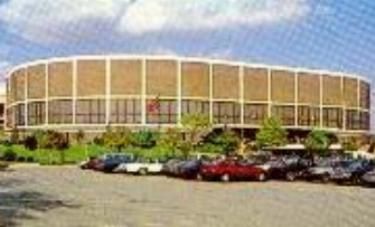
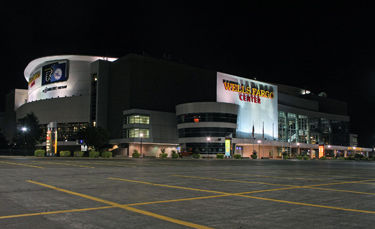
Arenas: (2) The Spectrum 1967/68-1995/96 Wachovia Center* 1996/97-Present *-Known as Corestates Center 1996-1998 & First Union Center 1998-2003 |
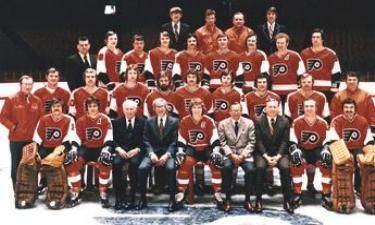
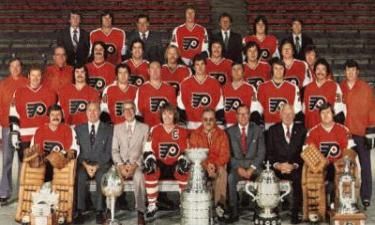
Stanley Cup Champions: (2) 1974, 1975 Stanley Cup Finals: (7) 1974, 1975, 1976, 1980, 1985, 1987, 1997 Conference Finals: (14) 1974, 1975, 1976, 1977, 1978, 1980, 1985, 1987, 1989, 1995, 1997, 2000, 2004, 2008 President's Trophy: None Division Champions: (15) 1968, 1974, 1975, 1976, 1977, 1980, 1983, 1985, 1986, 1987, 1995, 1996, 2000, 2002, 2004 Playoff Appearences: (33) 1968, 1969, 1971, 1973, 1974, 1975, 1976, 1977, 1978, 1979, 1980, 1981, 1982, 1983, 1984, 1985, 1986, 1987, 1988, 1989, 1995, 1996, 1997, 1998, 1999, 2000, 2001, 2002, 2003, 2004, 2006, 2008, 2009 |
Hall of Famers:(11) Keith Allen Coach GM 1969-1983 Bill Barber LW 1972-1984 Bobby Clarke C 1969-1984 Paul Coffey D 1996-1998 Dale Hawerchuk C 1995-1997 Roger Neilson Coach 1998-2000 Bernie Parent G 1967-71, 1972-79 Bud Piloe GM 1967/68-1970/71 Ed Snider Owner 1967-Present Darryl Sittler C 1981-1983/84 Allan Stanley D 1968/69 |
Retired Numbers: (5) 1 Bernie Parent G 1967-71, 72-79 4 Barry Ashbee D 1970-1974 7 Bill Barber LW 1972-1984 16 Bobby Clarke C 1969-1984 99 Wayne Gretzky C (Retired by NHL) |
©MMIX Tank Productions. Stats researched by Frank Fleming, all information, and team
names are property of the National Hockey League. This site is not affiliated
with the Philadelphia Flyers or the NHL. This site is maintained for research
purposes only. All logos used on this page were from Chris Creamer's Sports Logos Page. Page created on Page created on May 31, 2003. Last updated on December 9, 2009 at 1:05 am ET. Home |
Captains: (16) Lou Angotti 1967/68 Ed Van Impe 1968/69-1972/73 Bobby Clarke 1972/73-1978/79 Mel Bridgman 1979/80-1980/81 Bill Barber 1981/82-1982/83 Bobby Clarke 1982/83-1983/84 Dave Poulin 1984/85-1989/90 Ron Sutter 1989/90-1990/91 Rick Tocchet 1991/92 No Captain 1992/93 Kevin Dineen 1993/94 Eric Lindros 1994/95-1999/00 Eric Desjardins 1999/00-2001/02 Keith Primeau 2001/02-2005/06 Peter Forsberg 2006/07 Jason Smith 2007/08 Mike Richards 2008/09-Present |
All-Star Games Hosted: (2) 1976, 1992 All-Star Game MVP: (1) 1980 Reggie Leach RW |
Awards: Jack Adams Award (Top Coach): (4) 1974 Fred Shero 1980 Pat Quinn 1985 Mike Keenan 2001 Bill Barber Calder Trophy (Top Rookie): None Masterton Trophy (Dedication): (2) 1972 Bobby Clarke C 1989 Tim Kerr RW Lady Byng (Gentlemanly Play): None Selke Trophy (Defensive Fwd): (2) 1983 Bobby Clarke C 1987 Dave Poulin C Norris Trophy (Defenseman): None Vezina Trophy (Top Goalie): (4) 1974 Bernie Parent 1975 Bernie Parent 1985 Pelle Lindbergh 1987 Ron Hextall Hart Trophy (NHL MVP): (4) 1973 Bobby Clarke C 1975 Bobby Clarke C 1976 Bobby Clarke C 1995 Eric Lindros C |
Conn Smythe (Playoff MVP): (4) 1974 Bernie Parent G 1975 Bernie Parent G 1976 Reggie Leach* RW 1987 Ron Hextall* G *-Played on losing team |
Best Season: 1975/76 (51-13-16; 118 pts) Worst Season: 2006/07 (22-48-12; 56 pts) |
Odds and Ends: AHL Afilliate: Philadelphia Phantoms |
On The Air: Televsion: WPSG (Channel 57); Comcast Sportsnet Radio: WIP (610 AM) Broadcasters: Steve Coates, Jim Jackson, and Keith Jones-TV; Brian Propp and Tim Saunders-Radio Foster Hewittt Award Winners: (2) Mike Emerick 1980-1982, 1988-1993 Gene Hart 1967-1995 |

Alternate Logo 2002-Present |


Visit Our Sponsors Partner With: FantasyPlayers.com. Contact Fantasy Sports Ventures for advertising information. |