Nickname:
Selected because their owner was a member of a Northeastern political organization in Tammany Hall, that called themselves the Braves.

Colors
:
Blue
White
Red
 
Manager:
Bobby Cox 1990-

Stadium
:
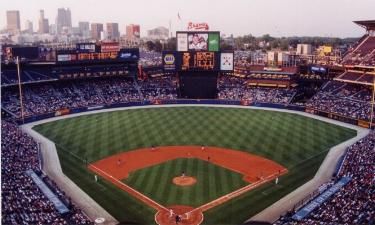
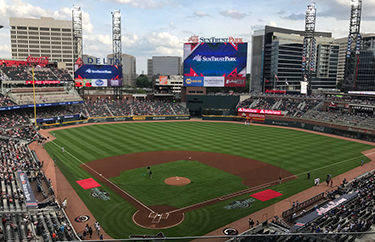
Turner Field 1997-
 
Logo
1990-Present
44th Season
First Game Played April 12, 1966


Address:
755 Hank Aaron Drive
Atlanta, GA 30315
Phone: (404) 522-7630

Web:
http://www.atlantabraves.com


Managers: (17)
Bobby Bragan 1966
Billy Hitchcock 1966-1967
Ken Silvestri 1967
Lum Harris 1968-1972
Eddie Mathews 1972-1974
Clyde King 1974-1975
Connie Ryan  1975
Dave Bristol 1976-1977
Ted Turner 1977
Dave Bristol 1977
Bobby Cox 1978-1981
Joe Torre 1982-1984
Eddie Haas 1985
Bobby Wine 1985
Chuck Tanner 1986-1988
Russ Nixon 1988-1990
Bobby Cox 1990-Present


Stadiums: (2)
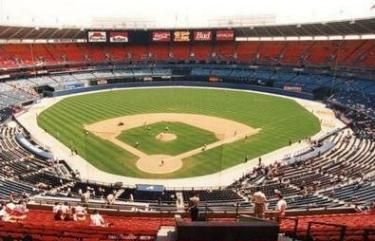
Fulton County Stadium 1966-1996
Turner Field 1997-Present
 
World Champions: (1)
1995

World Series Appearances: (5)
1991, 1992, 1995, 1996, 1999

LCS Appearances: (11)
1969, 1982, 1991, 1992, 1993, 1995, 1996, 1997, 1998, 1999, 2001

Division Champions: (16)
1969, 1982, 1991, 1992, 1993, 1995, 1996, 1997, 1998, 1999, 2000, 2001, 2002, 20003, 2004, 2005


Wild Card:
None
 
 
Hall of Famers: (7)
Hank Aaron OF 1966-1974
Orlando Cepeda 1B 1969-1972
Eddie Mathews 3B 1966

Phil Niekro RHP 1966-1983, 1987
Gaylord Perry RHP 1981
Bruce Sutter RHRP 1985-1988
Hoyt Willhelm RHP 1969-1970, 1971


Retired Numbers: (7)
  3 Dale Murphy OF 1976-1990
21 Warren Spahn LHP 1942, 46-64
35 Phil Niekro RHP 1964-1983, 1987
41 Eddie Mathews 3B 1952-1966
42 Jackie Robinson
(Retired by MLB)
44 Hank Aaron OF 1954-1974
 
 
All-Star Games Hosted: (2)
1972, 2000

All-Star Game MVP
: (1)
1994 Fred McGriff 1B
 
 
AWARDS
Manager of the Year: (3)
1991 Bobby Cox
2004 Bobby Cox
2005 Bobby Cox


Rookie of the Year: (4)
1971 Earl Williams C
1978 Bob Horner 3B
1990 David Justice OF
2000 Rafael Furcal SS


Fireman Award
: (1)
2002 John Smoltz LHP

Hank Aaron Award
: (1)
2005 Andruw Jones OF

Cy Young: (6)
1991 Tom Glavine LHP
1993 Greg Maddux RHP
1994 Greg Maddux RHP
1995 Greg Maddux RHP
1996 John Smoltz LHP
1998 Tom Glavine LHP


MVP: (4)
1982 Dale Murphy OF
1983 Dale Murphy OF
1991 Terry Pendelton 3B
1999 Chipper Jones 3B


LCS MVP: (5)
1991 Steve Avery LHP
1992 John Smoltz LHP
1995 Mike Deveraux OF
1996 Javier Lopez C
1999 Eddie Perez C


World Series MVP: (1)
1995 Tom Glavine LHP


Best Season:
1998 (106-56)

Worst Season
:
1988 (54-106)


Alternate Logo
2005-Present
No Hitters: (3)
8/5/1973 Phil Niekro
9/11/1991 Combined:
Kent Mercker (6) Mark Wohlers (2) Alejandro Pena (1)
4/8/1994 Kent Mercker

Cycle Hitters: (2)
9/23/1987 Albert Hall
8/14/2008 Mark Kotsay

Four HR Games: (1)
7/6/1986 Bob Horner

Unassisted Triple Plays
: (1)
8/10/2003 Rafael Furcal
 
On the Air:
Televsion:
WPCH (Channel 17); SportSouth; Fox Sports Net South

Radio
:
WKLS (750 AM) and WKLS (96.1 FM); WATB (1420 AM)-Spanish

Broadcasters
:
Chip Caray, Mark Lemke, Jon Sciambi, and Joe Simpson-TV; Jim Powell and Don Sutton-Radio; Pete Manzano and Fernando Palacios-Spanish

Ford C. Frick Recipients
: (1)
Milo Hamilton 1966-1975


Odds and Ends:
Official Cheer:
Tomahawk Chop

Moving Man:
Hall of Fame 3B Eddie Matthews Played for the Braves in three different cities.
 
 
Spring Training History: (2)
West Palm Beach, FL 1966-1997
Disney World, FL 1998-Present


On The Farm:
AAA: Gwinnett Braves
AA: Mississippi Braves
A: Rome Braves
A: Myrtle Beach Pelicans
R: Danville Braves
R: Gulf Coast Braves
ĐMMIX Tank Productions. Stats researched by Frank Fleming, all information, statistics, logos, and team names are property of Major League Baseball.  This site is not affiliated with the Atlanta Braves or MLB.  This site is maintained for research purposes only. All logos used on this page were from Chris Creamer's Sports Logos Page.
Page created on February 15, 2001. Last updated on June 6, 2009 at 2:20 am ET. 
Home


Historical Moments:

1966: On April 12th the Braves host the Pittsburgh Pirates for the first Major League Game in Atlanta. The game would go 13 innings before the Pirates won 3-2. The Braves would go on to finish in fifth place with an 85-77 record, in their first season in Dixieland, as Hank Aaron led the National League in home runs and RBI.

1967:
The Braves endure their first losing season in 15 years when they played in Boston as they finish in seventh place with a 77-85 record.

1968:
Hank Aaron's march for the all-time Career home run record begins to gather momentum as Aaron hammers his 500th career long ball. However, on the field the Braves once again play mediocre baseball finishing in fifth place with an 81-81 record.

1969:
With the acquisition of Orlando Cepeda the Braves are able to land a solid hitter to back up Hank Aaron who smashes 44 home runs. On the mound the Braves are led by knuckleballer Phil Neikro who wins team high 23 games. However, as late as August the Braves were mired in fifth place, but the braves would then catch fire and would out play the San Francisco Giants and Cincinnati Reds to capture the first ever Western Division Title with a record of 93-69. The Braves would host the first ever NLCS game, a 9-5 loss to the New York Mets. The Mets would go on to sweep the series in three games, but not before Hank Aaron hit three homers. 

1970: Hank Aaron collects career hit 3,000th, while Rico Carty captures the batting crown with an impressive .366 average. However, it's not enough for the Braves who finish in fifth place with a 76-86 record.

1971:
Hank Aaron hits 47 HR en-route to surpassing the 600 career home run barrier. Meanwhile catcher Earl Williams wins the Rookie of the Year by smashing 33 homers. However, the thirrd place Braves struggled just to finish above .500 at 82-80.

1972
:
Fulton County Stadium hosts the All Star Game, but the Braves hardly looked like stars as they finished in 4th place with a record of 70-84, while Hank Aaron continued to move up the home run leaderboard with 34 more to move to with in 41 of Babe Ruth's all-time record.

1973:
Benefiting from Fulton County Stadium's launching pad Dave Johnson (43), Darrell Evans (41), and Hank Aaron (40) become the first three players from the same team hit 40 or more in the same season. Aaron's hunt for the Babe's record continues as he surpasses the 700 mark and ends the season with 713 career homers, one short of Ruth's record of 714. However, it won't translate into wins for the Braves who finish in fifth place with a 76-85 record.

1974:
Hank Aaron does wait long to tie the Babe smacking his 714th HR on opening Day in Cincinnati. The Braves home season would begin four days later, on April 8th as the Braves took on the Los Angeles Dodgers, as National Audience watched on NBC. Aaron would step up to the plate against Dodgers left Al Downing, and would hammer number 715 over the left center power ally to become the all-time HR King. As Aaron rounded the bases two young fans ran out to congratulate him. Aaron's history making shot was not the only reason for excitement in Atlanta as the Braves posted a solid 88-74 record while finishing strong under Manager Clyde King who replaced Eddie Matthews in the middle of the season. Hank Aaron would go on to finish the season with 20 homers, before departing at the end of the year for the American League, and a position as the Milwaukee Brewers Designated Hitter. Aaron would go on to finish with an all-time high 755 career home runs.

1975:
Without all-time home run King Hank Aaron ,who was traded to the Milwaukee Brewers, the young Braves would falter finishing in fifth place with a miserable 67-94 record.

1976
:
Communications Magnate Ted Turner, who recently transformed a local UHF station into a nationwide Superstation, buys the Braves. Turner begins putting Braves games on the newly dubbed TBS, and the Braves can now be followed anywhere in the country. This move especially helps the Braves in markets where there are no Major League teams. This would cause Turner to bill the Braves as America's Team.  However, the move does not generate success on the field as the Braves finish last with a 70-92 record.

1977:
During a 17 game losing streak owner Ted Turner fires manager Dave Bristol, and takes over control of the team himself. The Braves would go on to lose the 2-1 in Tuner's managerial debut at Pittsburgh against the Pirates. Commissioner Bowie Kuhn did not take too kindly to the move and ordered Ted Turner to return to the owner's box. Turner would reinstate Dave Bristol as manager, and the Braves would go on to finish in last place with a 61-101 record.

1978:
After their miserable season the Braves are awarded the first pick overall in the Major League draft. The Braves use their pick on Arizona State slugger Bob Horner. Horner would sign with Braves, and immediately debut in Atlanta. In just 89 games Horner would smash 23 home runs, and drive in 63 RBI to earn the National League Rookie of the Year. However, the Braves don't fare much better finishing in the cellar again with a 67-93 record.

1979:
Knuckleballer Phil Neikro pulls of a rare feat of winning 21 games while losing 20 in the midst of another last place season in which the Braves post a 66-94 record.

1980:
With Dale Murphy hitting 33 home runs, the Braves end a string of last place season, and finish with a somewhat respectable 81-80 record.

1981:
The Braves are not a factor in either the first half or second half of the season posting a combined record of 50-56 as the season is split by a two month player's strike.

1982:
With new manager Joe Torre the Braves get off to a flying start and win their first 12 games establishing a new Major League record that would stand for five years. Meanwhile, Dale Murphy continues to establish himself as one of the premier hitters in the League smashing 36 home runs, and driving in 109 RBI, on the way to claiming the National League MVP. Despite, struggling most of the second half, the Braves would find themselves in a three way race for the Western Division Title going into the final weekend of the season. The Braves would win end up winning the division with an 89-73 record, as the San Francisco Giants and Los Angeles Dodgers killed each other off in the final three games.  In the NLCS the Braves would suffer a washout as 1-0 lead and a solid performance from Phil Niekro are wiped out as the rains interrupted Game 1 in St. Louis. The Cardinals would take advantage, winning 7-0, when Game 1 was played over from the start the following day. The Cards would go on to sweep the series in three games.

1983:
Dale Murphy collects his second consecutive National League MVP, while smacking 36 home runs, and driving in 121 RBI. The Braves would once again challenge for the Division title before falling three games short with an 88-74 record.

1984:
Dale Murphy hits 36 home runs for the third straight season, but the Braves struggle with the loss of Phil Niekro, and struggle all season to finish 80-82. After the season the Braves fire manager Joe Torre, as they get set for to rebuild the team.

1985:
A July 4th game against the New York Mets ends up going way into the night. The game was interrupted several times by rain and went deep into extra innings. In the wild back and fourth game, Pitcher Rick Camp was forced to hit for himself, and ended up tying the game again. The Braves would eventually fall to the Mets in 19 innings, but not before the clock struck 4 AM. In an odd side note the Braves decided to go ahead with scheduled fireworks show, and ballpark neighbors were greeted with a wake up call they would never forget. After the season, in which the Braves finished in fifth place, with a 66-96 record, the Brave rehire Bobby Cox, who managed the team from 1978-1981 to become the club's General Manager.

1986:
A four home run game by Bob Horner on July 6th is the only highlight of a 72-89 last place season. As symbol of the Braves futility the Braves would even lose the game in which Horner blasted four homers. The season would end up being Horner's last in Atlanta, as he would depart for a lucrative deal with Yakult Swallows in Japan. Horner was forced to sign with the Swallows, after not being able to find offer from another team during the era of collusion. In fact Horner's contract situation of one of several suspicious Free Agent deals that winter, which would be used to uncover the owner collusion of Free Agents.

1987
:
The Braves unveiled a new look resembling their looks of the past with the Tomahawk returning to their uniforms for the first time in 25 years when they were the Milwaukee Braves. However the current Braves would continue to sputter finishing in fifth Place again with a record of 73-88.

1988:
The Braves stumble out of the gates losing their first nine games on the way to a last place finish with an awful 54-106 record that is their worst since moving to Atlanta. 

1989
:
Despite an influx of young pitching talent the Braves remain a doormat in the National League Western Division, finishing in last place for the third time in four years with a record of 63-97.

1990
:
In the midst of another last place 65-97 season the Braves stun their fans by trading Dale Murphy to the Philadelphia Phillies. Bobby Cox would also see a change in position leaving his post as General Manager, to take over the reigns of Manager. Cox, would hold both jobs until the end of the season, when John Schurleholtz was brought in to run the front office. Although the Braves were mired in the cellar again signs of a bright future were not hard to find young arms John Smoltz, Tom Glavine, and Steve Avery were showing signs of becoming top notch pitchers while outfielder David Justice won the National League Rookie of the Year.

1991:
Through the first half of the season the Braves were improved, but were still nine and half games out of first at the All-Star Break. However, they were able to slice seven games off the lead in the first 12 games after the break. What followed was a thrilling stretch drive during which the Braves and Dodgers were never separated by more than two and half games after August 10th. Among many clutch performances were the National League's first-ever combined no-hitter by Kent Mercker, Mark Wohlers and Alejandro Peņa on September 11th against the San Diego Padres, and David Justice's game-winning, two-run homer off Rob Dibble of the Cincinnati Reds on October 1st, capping a comeback from a 6-0, first-inning deficit. The Braves finally clinched the division title on October 5th, after an eight game winning streak, the first six coming on the road, to set Atlanta records of 94 wins (including a 55-28 mark in the second half) and 2,140,217 in attendance. After the season Tom Glavine would earn the NL Cy Young, while 3B terry Pendleton captured the MVP. In the NLCS the Braves would face the Pittsburgh Pirates. After splitting the first games in Pittsburgh the series shifted before the Fulton County Stadium where the Tomahawk Chop was going strong. After the Braves took Game 3, the Pirates would take the next two games to return to Pittsburgh with a 3-2 series lead. However, the strong pitching of the Braves would not be stopped as Tom Glavine and NLCS MVP Steve Avery shutout the Pirates in the final two games to advance the Braves to the World Series. In the World Series the last to first Braves, would face the last to first Minnesota Twins. After the Twins took the first two games in Minnesota the series shifted to a soldout Fulton County Stadium. The Braves would win Game 3 in 12 innings on a Mark Lemke singled home David Justice in a game highlighted by a bone chilling collision at home plate involving Greg Olson and the twin Dan Gladden. The Braves would also win Game 4 in another thriller as Lemke, a .234 hitter in the regular season but a .417 batsman in this Series, tripled with one out in the ninth and the score tied at 2-2. He then raced home on journeyman Jerry Willard's fly ball to right, just avoiding the tag by catcher Brian Harper. After the Braves won Game 5 in a blowout the series shifted back to Minnesota with the Braves up three games to two. However, the Braves magic would end there, as the Twins won the final two games in extra innings to capture the World Series.

1992:
The Braves prove 1991 was not a fluke, by repeating as National League Western Division Champions with an impressive 98-64 record. In the NLCS the Braves once again face the Pittsburgh Pirates, and quickly jumped out to a 3-1 series lead. However, the Pirates would battle back to win the next two games to force a seventh and deciding game at Fulton County Stadium. The Pirates would take a 2-0 lead to the ninth Inning, but the braves would rally finally scratch the scoreboard, and with 2 outs had the tying and winning runs in scoring position. However, the Braves were down to one pinch hitter and that was little used Catch Francisco Cabrera. Cabrera would hit the ball through the shortstop hole to tie the game while slow-footed Sid Bream rounded third. Bream would slide home just under Mike Lavaliere tag to send the Braves back to the World Series with a dramatic 3-2 win. In the first ever International World Series the Braves faced the Toronto Blue Jays. After taking Game 1 the Braves took a 4-3 lead into the ninth Inning of Game 2. However, the Jays would win the game as Utilityman Ed Sprague blasted a two run Pinch Hit HR off Jeff Reardon to tie the series at agame apiece. The series would travel up north of the border for the first time ever, where the Jays won Game 3, with a Candy Maldonado single over a drawn in outfield in the ninth Inning. The Jays would also win Game 4 to take a 3-1 series lead. However, the Braves bounced back to send the series back to Atlanta with a 7-2 victory in Game 5. Down 2-1 in the ninth Inning the Braves used two out magic to tie the game and force extra innings. However, Dave Winfield would give the Jay a 4-2 lead with a dramatic double in the top of the 11th. The Braves would not go down without a fight scoring a run, and having the tying run on base before Otis Nixon's two out bunt attempt was fielded cleanly to give Canada its first ever World Series Championship.

1993
:
Through much of the first half of the season the Braves played solid baseball but found themselves far behind the San Francisco Giants, who were running away with the division. On July 19th the Braves acquired Fred McGriff in a trade with San Diego Padres. The next day before McGriff's Braves debut a press box fire, caused minor damage to Fulton County Stadium, after the fire was put out McGriff lit another fire hitting a HR to ignite a rally from 5-0 defect to a dramatic 8-5 win over the Cardinals. The fire caused by McGriff would rage out of control as the Braves would play 54-19 baseball over the last 73 games of the season to overtake the Giants ten game lead and win the Western Division by one game with a 104-58 record. However, the Braves one weakness would be exposed in the NLCS as the Philadelphia Phillies took advantage of the Braves weak bullpen to stun the Braves in six games to advance to the World Series.   

1994:
The Braves opened the campaign in the newly realigned National League attempting to capture their fourth straight division crown in their new home, the National League Eastern Division. The Braves began the season in record fashion, winning their first games, all on the road, during the streak Kent Mercker no hit the Dodgers, 5-0 on April 8th in Los Angeles. However, shortly after the All-Star Break the Montreal Expos would overtake the Braves for the division lead. The Braves would see the Expos race past them establishing a six game lead on August 12th, although not in first place, the Braves were in position for a Wild Card Berth with a record of 68-46, when a player's strike suddenly ended the season. After the aborted season Greg Maddux who led the National League in wins would capture his second straight Cy Young as a Brave, and third overall.  

1995:
When play resumed after a spring of replacement players, and court decisions the Braves saw most of their completion for the Division sold off and traded away as the Montreal Expos, could not afford to keep them. One of those players Marquis Grissom even landed in Atlanta. The Braves would cruise to the Division Title with a 90-54 record, 21 games better then their completion.  In the NLDS the Braves faced the third year Colorado Rockies. The Rockies would prove pesky sending Game 1 to extra innings, and winning Game 3 but the Braves would emerge victorious in four games. The Braves would go on to make quick work of the Cincinnati Reds in the NLCS sweeping them in four straight to advance to the World Series. In the World Series the Braves were matched up against the Cleveland Indians, who dominated the American League all year. The Braves would take the first two games of the series behind the pitching of Greg Maddux, and Tom Glavine. After the Indians won Game 3 in extra Innings the Braves would take a 3-1 series lead behind the pitching of Steve Avery, setting up Greg Maddux with a chance to close the series out in five games. However, the Tribe would defeat Maddux to send the series back to Atlanta. Prior to Game 6 David Justice popped off on how the fans were not fully behind the team, when Justice first come up he was booed, but it would quickly shift to cheers as his home run in the sixth inning gave the Braves a 1-0 lead. With World Series MVP Tom Glavine pitching one hit baseball for eight innings it was enough as Mark Wohlers came into close out the World Series, and gave Atlanta it's first ever World Championship.

1996
:
The Braves waltz to another National League Eastern Division title with a 96-66 record, while Greg Maddux sees his four year reign as Cy Young end with teammate John Smoltz earning the honors. After the Braves quickly dispatched the Los Angeles Dodgers in three games of the NLDS the Braves would move on to face the St. Louis Cardinals in the NLCS. Beating the Cardinals would not be as easy, and the Cards jumped out to a surprising 3-1 series lead. However, the Braves would come storming back blowing the Cardinals out in the final three games to advance to their fourth World Series in six years. The momentum carried on into the first two games of the World Series in which the Braves won by a combined score of 16-1, as Yankee Stadium. As the Series shifted to Fulton County, for what would the 30 year old stadium's final game Braves fans expected the Braves to cap off their second straight Championship with a sweep, but after the Yankees won Game 3, all of a sudden it was a series again. In Game 4 the Braves jumped out to a 6-0 lead, and were poised to take a 3-1 series lead, when the Yankees rallied. After slicing the lead in half in the 6th the Yankees would tie the game on a Jim Leyritz three run home run off Mark Wholers in the eighth inning. The Yanks would go on to win in extra innings, to tie the series at two games apiece. The Braves would ever recover, as the Yankees took the series in six games.

1997:
The Braves inaugurate Turner Field, which was used the previous summer for the Olympics, in style by winning 12 of their first 13 at the Ted. The Braves would go on to capture yet another Division Title with a 101-61 record, beating out the Wild; Card winning Florida Marlins by nine games. After sweeping the Houston Astros in the NLDS the Braves would face the same Marlins in the NLCS. However, the Marlins would prove pesky winning Game 1 with the stellar pitching of Kevin Brown, after the Braves won Game 2, the series would go to Miami, where noted Braves killer Tony Saunders beat the Braves again to give the Marlins a 2-1 series lead. The Braves would bounce back to take Game 4, and would go into a crucial Game 5 facing an unproven rookie. However, the rookie named Livan Hernandez would have the game of his life striking out 15 Braves on the way to giving the Marlins a 3-2 series lead, as the series shifted back to Atlanta. However, even the home field could not save the Braves from the upset as the Marlins behind Kevin Brown too Game 5 to advance to the World Series.

1998:
Another amazing season for the Braves, as Tom Glavine won the National League Cy Young Award, his second, with a 20-6 record. The team wins 106 games and its seventh division title in eight years. The Braves met the Chicago Cubs in the Divisional Playoffs and won easily in three straight games. The San Diego Padres were the opponents in the NLCS. After losing the first three games, the Braves won two dramatic contests in San Diego, before falling in six games.

1999:
At the outset of spring training, the Braves were stunned to hear that Andres Galarraga would be lost for the season because of non-Hodgkin's lymphoma a form of cancer in a bone in his lower back, and also saw closer Kerry Ligtenberg go down with a season-ending medial collateral ligament tear in his right elbow. Despite these losses and season-ending injuries to Javy Lopez, Odalis Perez and Rudy Seanez during the summer, Braves managed to win 103 games and claim their eighth division title in nine years. The team blew open a tight race with the New York Mets by taking five of six games from the New Yorkers in late September, highlighted by Chipper Jones' four home run barrage in a three game sweep in Atlanta, which served as his springboard to the MVP Award. After losing Game 1 in the NLDS the Braves would bounce back to take the next three to advance to the NLCS for the 8th straight season. In the NLCS the Braves would jump out quickly grabbing a 3-0 series lead, but the Mets would win the next two in dramatic fashion to send the series back to Atlanta 3-2. The Braves would jump out to a 6-0 lead in the sixth game but the Mets would comeback again and send the game to extra inning. The Braves would eventually win the game and the series on a bases loaded walk too Gerald Williams, but the Braves were heading into the World Series tired out. In the World Series the Braves faced the New York Yankees for the right to be called team of the 90's. The Braves would see a 1-0 lead melt in the last innings of Game 1, as the bullpen allowed four runs in the eighth inning, as the Braves lone hit was a Chipper Jones home run. After losing Game 2, the Braves would grab a lead in Game 3 but two home runs by Chad Curtis including an extra innings game winner would give the Yanks a 3-0 series lead. Beaten and disheartened Game 4 was a mere formality as the Braves saw the Yankees completed the sweep.

2000
:
In a season highlighted by a 15-game winning streak the Braves finish 95-67 to edge out the New York Mets by one game on the way to another Division Title. However, a loss in the final game of the season cost the Braves home field advantage in the NLDS. Subsequently the Braves are swept by the St. Louis Cardinals as Division Series as the Braves usually reliable pitchinga saw sub par outings by Greg Maddux (4.0 IP, 5 ER), Tom Glavine (2.1 IP, 7 ER) and Kevin Millwood (4.2 IP, 4 ER) led to a quick three-game exit ending their streak of NLCS appearances.

2001:
Celebrating their tenth season winning divisions the Braves once again finish in first place. However, it is not done with same style as usual, as the Braves only manage to win 88 games to hold off a season long challenge from the Philadelphia Phillies, and late surge by the New York Mets. Heading into the NLDS the Braves were the underdogs going up against the Central Division Champion Houston Astros, but an eighth inning, three run homerun by Chipper Jones gave the Braves the first game. The momentum of this win helped the Braves take the next two and complete the three game sweep over the Astros. In the NLCS the Braves would face the Arizona Diamondbacks. After splitting the first two games in the desert the series moved to Atlanta where the D-backs won Game 3 behind the stellar pitching of Curt Schilling. The D-backs would rough up a shaky Greg Maddux in Game 4 to give the D-backs a 3-1 series lead, before Randy Johnson shut down the Tomahawk for another season with a win in Game 5.

2002:
The Braves have cruise to their eighth straight National League Eastern Division Title leading by more then double digits most of the season on the way to a 19 game cushion at season's end with a 101-59 record. Along the way the Braves found away to revitalize John Smotlz career as he becomes the closer setting a National League record in saves with 55. However, come the postseason their would be no saving the Braves as they would fall in the Division Series to the San Francisco Giants in five games. Tom Glavine who was the first of the dominating Braves pitchers to make his debut in 1987 would stun Braves fans following the season when he departed via free agency signing with Braves rival New York Mets.

2003:
Despite the loss of Tom Glavine the Braves remained the dominant team in the National League East winning the division, easily again with a record of 101-61. However, unlike previous seasons it was not the Braves pitching that made the difference it was their hitting as they led the league in most offensive team categories, including runs, homers, and batting. Leading the way for the offensive attack was Javier Lopez who hit a record 43 home runs for catchers. Joining Lopez in the attack was Gary Sheffield, Andruw Jones, and Chipper Jones who all had over 100 RBI. Sheffield and the Jones boys would joined by middle infielders Rafael Furcal and Marcus Giles, who had a breakout season with 21 homers joined in to give the high scoring Braves five different players with over 100 runs scored. On the mound the Braves were led by Russ Ortiz who won a league high 21 games. However, at times the Braves pitching struggled, as Greg Maddux was mediocre most of the season, while the Braves team ERA was an average 4.09. In the playoffs the Braves would be matched up against the Chicago Cubs who had not won a playoff series in 95 years. However the Cubs 1-2 pitching punch of Kerry Wood and Mark Prior would shut down the Braves bats all series taking Game 1, 3 and 5 to stun the Braves in a best of five series. Following the season the Braves would suffer more losses as they lost Lopez, Sheffield, and Maddux to free agency, as the Braves were forced to cut payroll.

2004:
The Braves would sorely miss Gary Sheffield and Javier Lopez early in the season as they got off to a slow start that saw them sitting with a 33-39 record on June 25th along the way Braves. The low point of the early struggles came in back-to-back games in May when they were struck out 18 times against Milwaukee Brewers ace Ben Sheets, and had a Perfect Game thrown against them by Randy Johnson of the Arizona Diamondbacks. However, as summer began the Braves bats began to heat up led by J.D. Drew who had a team high 31 homers as the Braves climbed back over .500 and into the race in a mediocre NL East. In July and August the Braves were unbeatable winning 40-of-54 games to climb back into first place where they would go on to win their 13th straight division title in completed seasons with a 96-66 record. Earning recognition for the Braves stunning in season turnaround was Bobby Cox who was named Manager of the Year for the first time since 1991 when the Braves run began. In the playoff the Braves had a familiar opponent in the Houston Astros, whom they had beaten in the NLDS 3 times previously. However, from the start things would be different as Carlos Beltran caught fire as helped power the Astros to a 9-3 win in Game 1, after Rafael Furcal even the series with a two run walk off home run in the 11th Inning of Game 2, Beltran again hammered Braves pitching with four RBI in 8-5 Astros win. Facing elimination in Game 4, Adam LaRoche hit a three run homer in the sixth inning to tie the game 5-5, as J.D. Drew smashed a solo homer to give the Braves a 6-5 win which sent the series back to Atlanta for a decisive 5th game. However, for the third year in a row the Braves season would end in Turner Field as the Astros won in rout with Beltran hitting two homers and knocking in five runs to bring his series total to four home runs and nine RBI as the Astros won 12-3.

2005
:
Once again the Braves would get off to a slow start as they found themselves hovering around .500 in the middle of June at 33-32. The Braves would have a myriad of problems as newly acquired closer Danny Kolb struggled badly and would eventually be seen as unreliable leaving the Braves to have a closer by committee. Meanwhile injuries to players like Chipper Jones, and pitchers like Mike Hampton led to unproven Rookies to get the call early. The rookies would provide just the spark the Braves needed as Outfielder Jeff Francoeur and Catcher Brian McCann who grew up doing the Tomahawk Chop in the suburbs of Atlanta made an immediate impact after being called up from AA Mississippi, establishing themselves as fans favorites as the Braves began their move as the All-Star Game approached winning 17-of-22 to climb within a few games of first place. After the All-Star Break the Braves remained hot quickly grabbing first place away from the Washington Nationals with a help of a three game sweep at the end of July. While it was the young Braves helped provide the spark it was Andruw Jones who was the team's MVP with a franchise record 51 homers which helped him become the first Brave to win the Hank Aaron Award. On the mound the Braves were led by John Smoltz and newly acquired Tim Hudson who each won a team high 14 games. However, it was perhaps the performance of Jorge Sosa who went 13-3 after being picked up off the trash heap from the lowly Tampa Bay Devil Rays that helped the Braves continue  their starting pitching dominance, which was extremely important with the bullpen struggling as badly as it did. The Braves would go on to win the National League East again by two games over the Philadelphia Phillies with a 90-72 record, extending their remarkable run to 14 straight Division Titles in completed seasons, as Bobby Cox won another Manager of the Year Award. In the playoffs the Braves would draw a rematch with the Houston Astros, once again they would fall behind losing Game 1 as Tim Hudson struggled 10-5. The Braves would rebound to win Game 2 behind Smoltz 7-1, as the series shifted to Houston. After losing Game 3, the Braves appeared to be bringing the series back to Atlanta for decisive fifth game as they led 6-1 in the eighth Inning. However, their pen would implode as the Astros rallied to send the game to extra innings on an eighth inning Grand Slam by Lance Berkman and a solo shot by Brad Ausmus in the ninth inning. From their each side would put up nothing for the next eight innings as Roger Clemens came in the game and silenced the Braves bats, before Chris Burke hit a walk off homer off Joey Devine to end the Braves season again 7-6.

2006:
It is written that all good things must come to an end and for the Braves the end came in 2006, as they once again got off to a slow start and ended April with a 10-14 record, and found themselves five games behind the New York Mets. The Braves would rebound for a strong, May climbing back over .500 at 28-25. However, in June the bottom simply fell out as injuries and an unreliable bullpen combined smother the Braves as they post a terrible 6-21 record their worst month since moving to Atlanta. The Braves bounced back in July and began to make their move to get into Wild Card contention after the All-Star Break as they came out smoking, scoring ten or more runs in five straight games. However, the Braves came back to reality at the end of the month as the Mets came into Atlanta and swept the Braves in three straight games erasing any hope of another division title. The Braves would do some retooling at the trade deadline acquiring Bob Wickman for the closer role, which was a weak spot for the Braves all season as they blew a league high 29 saves. However it would not be enough as the Braves never made a run, and finished the season in third place with a record of 79-83.

2007
:
With the hopes of regaining their crown in the Eastern Division, the Braves concentrated on their bullpen by resigning Bob Wickman, while acquiring Mike Gonzalez, and Rafael Soriano. Early on it worked as the Braves jumped out to a fast start winning seven of their first eight games as they ended April in first place with a record of 16-9. However, in May the Braves struggled slipping behind the New York Mets, as Andruw Jones playing for a new contract found himself helplessly in a season long slump as he ended the season with a career low batting average .222, with 26 home runs and 94 RBI. The Braves struggles continued into June, as they posted a dreadful 4-11 record and fell to .500 on June 24th. Meanwhile the bullpen was not holding up as planned as Wickman struggled and Gonzalez was lost for the season after needing Tommy John surgery on his elbow. While Andruw Jones struggled, Chipper Jones continued to put up an All-Star performance as he became the Braves all-time leading home run hitter since the club moved to Atlanta. Another longtime Brave making history was John Smoltz who took over the franchise lead in career strikeouts. Still struggling to live up to expectations the Braves landed slugging 1B Mark Teixiera along with reliever Ron Mahay from the Texas Rangers at the trade deadline for Ron Mahay from the Texas Rangers for Jarrod Saltalamacchia and four minor-leaguers. Teixiera made an instant impact hitting a three run homer in his Braves debut as the Braves clubbed the Houston Astros at Turner Field 12-3. Teixiera would also hit homers in his next two games, but the Braves were unable to get the win, as the Braves never made their move on the division leaders, as an ineffective Bob Wickman was released in August. The Braves would end up the season finishing in third Place with a record of 84-78, as the Braves said good bye to Andruw Jones, choosing not to resign their longtime stalwart in Centerfield. The Braves would also say good bye to TBS following the season, as the one time Super Station evolved to a National Cable powerhouse, carrying a national package of Sunday Afternoon Baseball games and the postseason. However, the off-season would see the return of another Braves legend as they signed Free Agent Tom Glavine, who spent five years with the Mets, winning his 300th game in 2007.

2008
:
With the return of Tom Glavine, the Braves entered the season with renewed optimism. However, Glavine would only win twice, before injuries forced him to the sideline. Injuries also hit John Smoltz who made just five starts before undergoing season ending shoulder surgery. While Tim Hudson was forced to undergo Tommy John surgery, to fix a torn elbow ligament. With the starting staff ravaged with injuries the Braves never were seriously in the playoff chase. Below .500, the Braves decided to cut their losses and start concentrating on the future after the All-Star Break as they traded free agent to be Mark Teixeira to the Los Angeles Angels for first baseman Casey Kotchman and minor league RHP Stephen Marek. While Mark Kotsay who was acquired in the off-season from the Oakland Athletics, was dealt to the Boston Red Sox for a minor leaguer. After the trades, August would be a horrible month for the Braves on and off the field, as they posted a terrible 9-20 record, while longtime announcer Skip Caray died on August 3rd. The Braves would go on to finish in fourth place with a 72-90 record. Following the season the Braves would not re-sign free agent John Smoltz, who after 20 years in Atlanta, decided to continue his career with the Boston Red Sox. The Braves would also say good bye to another longtime announcer as Pete Van Wieren announced the retirement following the season. While the Braves initially decided to re-sign Tom Glavine, he would be released for ever pitching another game for them in 2009. Meanwhile the Braves, rebuilt their pitching staff free agent pitcher Derek Lowe to a four-year contract, while trading for Javier Vazquez, whom they acquired along with Boone Logan, from the Chicago White Sox for catcher Tyler Flowers, shortstop Brent Lillibridge, third baseman Jon Gilmore and pitcher Santos Rodriguez. The Braves also would take a flyer on Japanese pitcher Kenshin Kawakami.

Fantasy Players Network Banner
Fantasy Players Network

Web

Visit Our Sponsors
Partner With:
FantasyPlayers.com. Contact Fantasy Sports Ventures for advertising information.
Mascot:
Homer
Mascot:
Rally